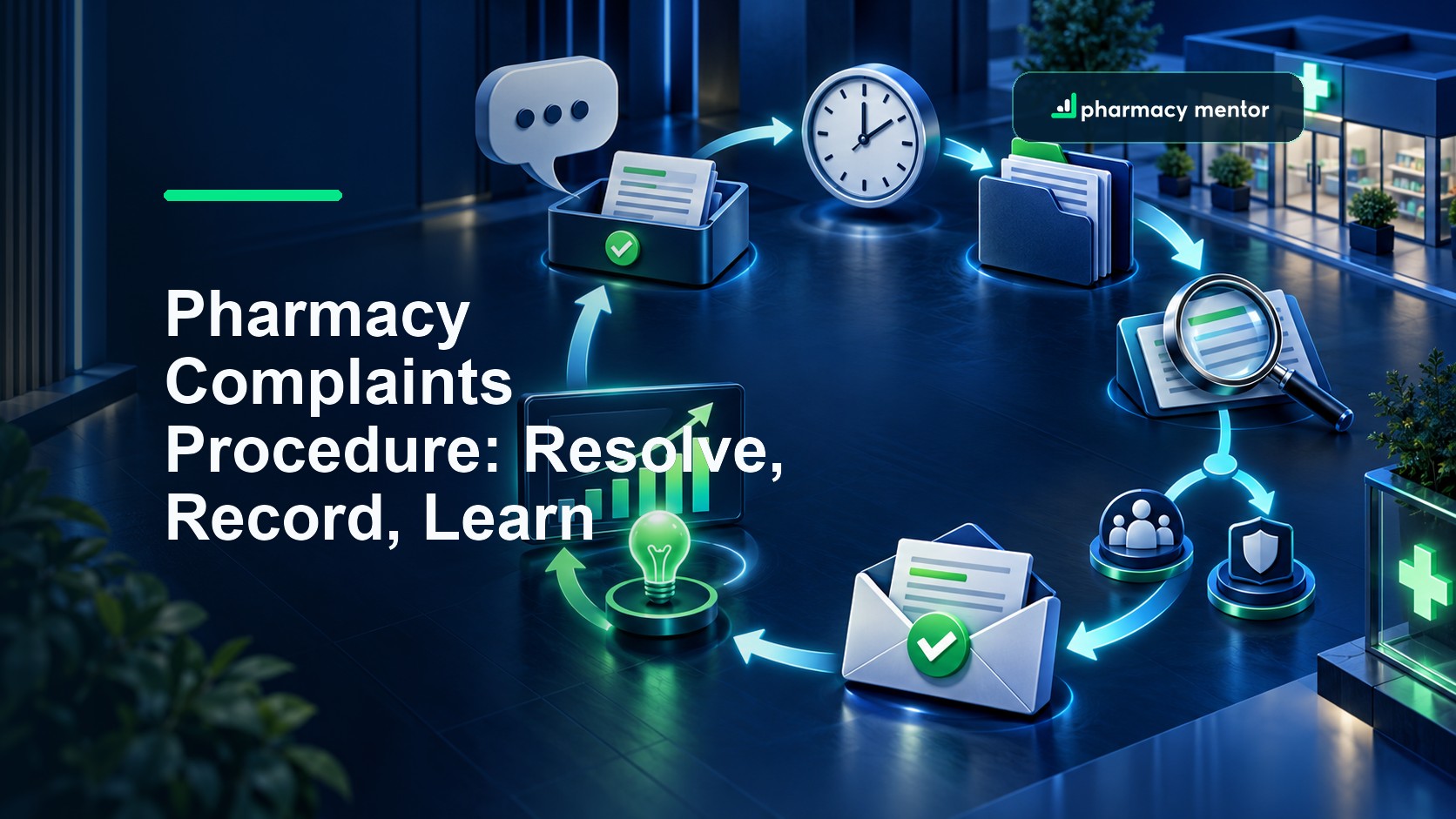
A pharmacy complaints procedure is a controlled route from a person's concern to a fair response and a visible service improvement. It should make the pharmacy easy to approach, preserve relevant evidence, protect confidentiality, separate investigation from assumption and show what changed after the outcome.
For community pharmacy owners in England, the process also sits inside NHS contractual and statutory requirements. Private services, data-protection complaints, professional concerns, incidents and safeguarding issues can involve different or additional routes. The first task is to identify what has been raised and who must own it.
What should a pharmacy complaints procedure do?
Publish a clear route, receive concerns in accessible ways, resolve simple issues early where appropriate, acknowledge formal complaints, agree the issues and desired outcome, investigate impartially, communicate a reasoned response, explain escalation routes, record the result and turn recurring themes into controlled improvement. Serious safety, safeguarding, conduct or data concerns must also enter the correct parallel process.
Define the scope and accountable roles
The NHS pharmaceutical services regulations require an NHS pharmacist in England to have complaints arrangements that comply with the 2009 NHS complaints regulations. Community Pharmacy England's owner-focused complaints guidance, updated on 1 October 2026, connects that duty to the community pharmacy contractual framework.
The 2009 complaints regulations require efficient handling, proper investigation, respect and courtesy, assistance, a timely response, communication of the outcome and action where necessary. They also require a responsible person and a complaints manager. Those can be the same person, but the procedure should still distinguish accountability for the system from day-to-day case handling.
Write a responsibility map for the actual business. A single independent may use the owner or superintendent as responsible person and another trained colleague as complaints manager. A group may have branch intake, central investigation, clinical review and final sign-off. State who covers absence and who handles a complaint about the usual decision-maker.
This guide focuses on NHS community pharmacy complaints in England. Owners in Scotland, Wales and Northern Ireland should follow the relevant national arrangements and contract. Private-service complaints need the route promised in the service terms and any applicable provider or professional requirements.
Make complaints easy to raise
A person should not need to understand the pharmacy's corporate structure before being heard. Publish a concise route in the pharmacy and on the website, with options such as speaking to the team, telephone, post and a secure digital channel. Explain what information helps, what will happen next, how accessibility support can be requested and where the privacy notice applies.
Train every team member to recognise a complaint even when the person uses different words. “I want someone to explain why this keeps happening” may be a complaint. Do not force a person to use a special phrase or form before logging the concern.
Some oral complaints can be resolved to the person's satisfaction by the end of the next working day and are treated differently under the NHS regulations. That is an opportunity for prompt service recovery, not a reason to keep an inadequate record or discourage a formal complaint. Confirm what was resolved and capture any learning proportionately.
| Intake field | Purpose | Control |
|---|---|---|
| Complainant and authority | Identifies the person and whether they act for somebody else | Check consent, capacity or representative authority without collecting unnecessary data |
| Concern and impact | Records what happened and why it matters | Use the person's words before translating them into internal categories |
| Desired outcome | Shows what the person hopes will happen | Be clear about what is possible without promising the result |
| Service and date | Locates the event, records and people involved | Preserve evidence early and record the source |
| Risk flags | Identifies safety, safeguarding, conduct, data or legal routes | Start parallel escalation without losing the complaint |
| Contact preference | Supports accessible, agreed communication | Record consent for electronic communication where required |
Triage without dismissing the concern
Classify the complaint to allocate the right investigator, not to reduce its importance. Useful categories may include clinical care, dispensing or supply, communication, conduct, access, booking, delivery, payment, privacy, website, prescribing, advertising and contractor performance.
Ask whether the same facts indicate an incident, near miss, safeguarding concern, fitness-to-practise issue, controlled-drug concern, medicine defect, adverse event, data breach or legal claim. Each route has its own decision-maker and timetable. Logging a complaint does not replace them, and opening a parallel process does not remove the duty to communicate appropriately with the complainant.
Data-protection complaints now have an additional UK-wide control. The ICO's June 2026 guidance says organisations must provide a clear route, acknowledge a data-protection complaint within 30 days, investigate appropriately and communicate the outcome. Use the current ICO data-protection complaints guidance and obtain advice for complex cases.
If several organisations are involved, do not send the person around the system. NHS England explains that complaints involving more than one organisation should receive a coordinated response. Its NHS complaints route also explains that a person may complain to the service provider or the commissioner, and identifies local integrated care boards for pharmacy complaints.
Plan a fair investigation
Acknowledge the complaint, summarise the issues in neutral language, ask what outcome the person seeks, name the contact and agree a realistic communication plan. The Parliamentary and Health Service Ombudsman's NHS Complaint Standards emphasise early resolution, clear ownership, fairness, accountability and learning.
Create a short investigation plan before gathering opinions. For each issue, identify the question, relevant standard or service promise, records, people to speak to, reviewer and target date. Preserve the original record and record later annotations separately. A screenshot or system export should show its source and time; an undocumented copy pasted into an email may lose useful context.
- Give the complainant a fair opportunity to clarify the concern.
- Give staff and contractors a clear account of the issue and an opportunity to respond.
- Use a suitable independent clinical opinion where the complaint concerns clinical care and the usual reviewer was directly involved.
- Separate confirmed evidence, conflicting accounts and reasonable inference.
- Check the standard, SOP, service specification and information available at the time.
- Record why further evidence was or was not proportionate.
Support staff who are complained about without treating support as automatic defence. The GPhC's standards for registered pharmacies expect a culture of openness, honesty and learning. A fair process protects both the complainant and the team.
Write a response that answers the complaint
The final response should be understandable without the investigation file. Restate each issue, explain the evidence considered, set out the finding and reasoning, acknowledge impact, apologise where appropriate, describe any remedy or improvement, and explain the next route if the person remains dissatisfied.
Do not use a general statement such as “staff have been reminded” when the evidence supports a more specific action. Say what changed, who owns it, when it will be checked and how the pharmacy will know it worked. Avoid defensive legal language copied from another case.
If the full response will take longer than agreed, contact the complainant before the date passes, explain why and set a revised plan. Silence makes even a careful investigation look uncontrolled.
Convert complaints into service learning
Close the case with two separate records: the response to the person and the internal improvement decision. The improvement record should identify the theme, root or contributing factors, action, owner, due date, evidence and effectiveness review.
Review complaint themes alongside incidents, near misses, audit findings, claims, staff concerns and service data. One delivery complaint may be an isolated error; a pattern across branches may show a booking, labelling, route-planning or communication problem. Our pharmacy SOP guide explains how to make controlled procedures follow the work, while the pharmacy risk-assessment guide helps turn repeated evidence into better controls.
The 2009 regulations require complaint records, monitoring and an annual report. Design the dataset at the start: received date, theme, service, branch, outcome, response timing, learning, action status and escalation. Keep personal details out of the thematic dashboard and restrict case-file access.
Keep the public complaints route accurate
Test the website route on mobile. Can a person find it from the footer, understand whether it covers NHS and private services, use the contact channel, request an accessible alternative and see what happens next? Check that the listed company, pharmacy, address and escalation route match the actual provider.
Do not collect detailed health information through an ordinary contact form unless the channel and purpose are designed for it. Explain what information is needed, where urgent clinical or safety concerns should go and which channel is not monitored continuously.
Review the page when ownership, ICB contacts, service terms, privacy law or the complaints manager changes. A procedure hidden in an old PDF is not a reliable public route.
A 30-day pharmacy complaints procedure review
- Week one: map NHS, private, data, safety and professional routes; confirm accountable roles.
- Week two: test intake, acknowledgement, evidence preservation, consent and accessibility.
- Week three: sample closed cases for issue-by-issue reasoning, response quality and recorded learning.
- Week four: update the public page, team training, dashboard and action-review cadence.
Pharmacy Mentor can help pharmacy owners design clearer public journeys, controlled digital operations and accountable service information. Explore our pharmacy strategy support, or book a consultation to review how your website and operating systems support complaints, governance and learning.
Frequently asked questions
Does a community pharmacy need a complaints procedure?
Yes. In England, NHS pharmacists must have arrangements that comply with the NHS complaints regulations. Private services and other UK nations may add different requirements, so owners should map the routes that apply to their actual services.
Can a pharmacy resolve a complaint verbally?
Some oral complaints resolved to the person's satisfaction by the end of the next working day are treated differently under the NHS regulations. The pharmacy should still confirm the resolution and record proportionate learning rather than discouraging a formal complaint.
What should a pharmacy complaint response include?
It should address each issue, explain the evidence and reasoning, state the outcome, acknowledge impact, apologise where appropriate, describe remedies or improvements and explain the next escalation route.
Should complaints and incidents use the same process?
No. They may arise from the same facts and should be connected, but an incident, safeguarding concern, data breach, conduct issue or legal claim can require a separate route and timetable. Starting that route does not remove the need to handle the complaint fairly.

Saam Ali
Founder & CEO, Pharmacy Mentor · MRPharmSSaam Ali is a pharmacist, digital strategist and the founder of Pharmacy Mentor. He has worked across community pharmacy, healthcare marketing and digital product development since 2012, helping independent pharmacies build modern online services and reach more patients.