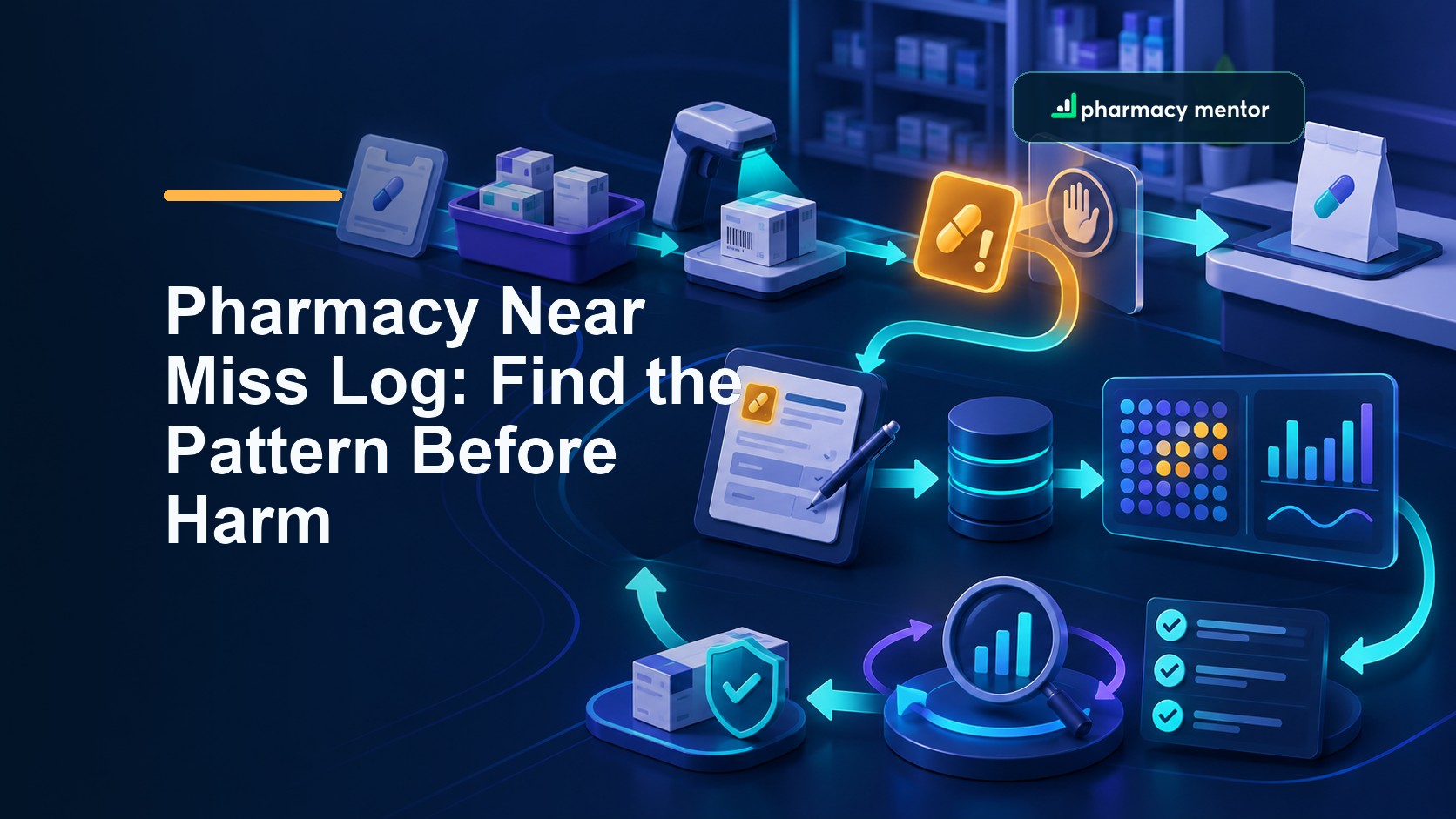
At Friday's review, five near misses may look unrelated: a wrong strength, an unclear shelf location, an interrupted check, a bag filed in the wrong place and a label attached to the wrong pack. Put the records in sequence, and a shared condition may emerge.
A pharmacy near miss log is valuable because it preserves that early warning. It should help the team understand what nearly happened, where the control worked, which conditions contributed and what needs to change. Counting entries without learning from them creates administration, not assurance.
What should a pharmacy near miss log do?
Make reporting quick, factual and safe. Capture the stage, intended and actual item or action, how the issue was found, relevant conditions, immediate response and review route. Use a consistent classification plus concise free text, protect access, review patterns with context, assign proportionate actions and record whether those actions changed the work. Keep the near miss route connected to—but distinct from—the pharmacy's incident, complaint, safeguarding, data and other escalation processes.
Define near miss, incident and escalation routes
Write the local definitions into the reporting procedure and train the team with examples. NHS England's current community pharmacy incident-reporting guidance says pharmacies must keep a patient safety incident log and should also maintain a record of errors identified as part of the checking process—near misses—for internal review and learning. The incident log and near miss record have related purposes, but they are not interchangeable.
This article uses “near miss” for an error or unsafe condition identified before it reached the person. The pharmacy's procedure should say what happens when a medicine or service has reached the person, when harm may have occurred, or when the facts also indicate a safeguarding concern, data breach, controlled-drug issue, defective medicine, occupational incident or other reportable event. Do not downgrade an incident because the immediate outcome appears minor.
For NHS community pharmacy in England, the 2013 pharmaceutical services regulations include an approved incident-reporting system and arrangements for analysing and responding to critical incidents within the clinical-governance requirements. Pharmacies elsewhere in the UK, and private or online services, need to map the national, contractual, professional and organisational routes that apply to their work.
Create a one-page decision map showing which route to use, who must be contacted and when. A team member should not have to decide alone whether a concern is “serious enough” while the evidence is disappearing.
Choose pharmacy near miss log fields that support learning
A long form reduces completion; a thin form produces little insight. Choose the minimum fields that let the pharmacy reconstruct the process and compare recurring conditions. Use structured categories for analysis and short factual text for context that categories cannot hold.
| Field | Useful content | Why it matters |
|---|---|---|
| When and where | Date, time, branch, service and workflow stage | Reveals timing, location and workload patterns |
| What was intended | Correct item, strength, form, quantity, label or action | Defines the expected state |
| What nearly happened | Observed difference stated without blame | Supports consistent classification |
| How it was found | Check, person, scanner, alert, patient query or other control | Shows which barrier worked |
| Conditions | Location, similar pack, interruption, staffing, system, lighting or handover context | Supports investigation of contributing factors |
| Immediate response | Correction, segregation, check, escalation and evidence preserved | Records safe control of the event |
| Review | Theme, owner, action, due date and effectiveness check | Connects the entry to improvement |
Avoid a form that begins and ends with the name of the person involved. Roles may be relevant to training, supervision or access, but the primary analytical unit should be the work and its controls. Ask what conditions made the error possible and what stopped it leaving the pharmacy.
Use the minimum personal data needed for the purpose and follow the pharmacy's retention, access and information-governance rules. A near miss that did not reach a person will often need a different data set from a patient safety incident. Do not copy identifiable patient information into a general learning spreadsheet merely because the field exists.
Make reporting easy and psychologically safe
The reporting rate depends on what happens after someone speaks up. If every entry triggers public blame, an impractical form or no visible improvement, the safest-looking dashboard may belong to the least open team.
The GPhC knowledge hub describes notable practice in which a pharmacy logged near misses, discussed trends and used reflective statements for repeated similar events. The value was not a form alone; it was the way the team used the record to change practice and deepen learning.
- make the reporting route available at the place and time the issue is found;
- allow an immediate safe correction before asking for detailed reflection;
- train permanent, temporary and locum staff on the same local process;
- thank people for making risk visible and avoid automatic blame language;
- explain who can see the record and how it will be reviewed; and
- close the loop by showing what changed and what still needs work.
Review patterns without misleading totals
Review individual entries promptly where the potential consequence, recurrence or uncertainty warrants it. Then run a regular thematic review across the period. Group by workflow stage, error type, medicine or pack characteristic, location, time, service, detection control and contributory condition. Keep enough free text to understand the sequence behind the category.
Use denominators where they can be defined accurately. Twenty near misses during a period of changed volume, new staff, an automation migration or an expanded service cannot be interpreted from the count alone. Compare the number and type of records with workload, team composition and process changes, and retain an “unknown” category rather than forcing incomplete evidence into a confident explanation.
Do not treat fewer reports as proof of safer work. A fall may mean an improvement, but it may also mean poorer access, uncertainty about definitions or a less open culture. Use observation, audit, staff discussion, incident records, complaints and other evidence alongside the log.
| Pattern | Question | Possible next evidence |
|---|---|---|
| Repeated similar packs | Is selection difficult because of location, appearance, naming or replenishment? | Shelf observation, pack sample and location history |
| Cluster at one time | What changes in workload, staffing, interruption or handover? | Rota, queue, task and break pattern |
| One control finds most issues | Is the barrier strong, or are earlier stages weak? | Process walk-through and control test |
| Few records from one area | Is risk lower, or is reporting harder there? | Team discussion, observation and access check |
| Action repeats each month | Was the action implemented and tested? | Owner, due date, evidence and effectiveness review |
Connect emerging themes to the pharmacy's clinical-governance system and risk assessments. The log is one source of evidence within a wider assurance picture.
Turn findings into controlled action
“Staff reminded” is sometimes appropriate as an immediate step, but it rarely proves that a recurring system weakness has been controlled. Choose an action that matches the contributing factor and assign an owner, due date, evidence requirement and effectiveness check.
- Describe the pattern. State what has repeated, where and under which conditions.
- Check the evidence. Observe the work and verify records before settling on a cause.
- Select the control. Consider physical layout, system design, procedure, staffing, training, supplier or communication changes.
- Implement visibly. Update the controlled source, brief the affected team and remove superseded instructions.
- Test effectiveness. Define what will be observed or measured, by whom and when.
- Reopen if needed. A repeated event after the action is new evidence, not an inconvenient exception.
If shelving or location contributes, use the evidence to change the physical system. The pharmacy shelving buyer's guide explains how pick observation, usable capacity, reach and location control should shape a storage project. If the issue is procedural, connect the action to the current pharmacy SOP and verify that the written route still matches the work.
Choose paper or digital tools deliberately
Paper can be fast and visible at one site; a digital system can improve classification, remote review, access control and multi-branch analysis. Either can fail. A paper form may remain unread in a folder, while a digital form may have weak permissions, confusing fields or no reliable export.
For any system, test:
- how quickly a team member can create a record during real work;
- role-based access, authentication and audit history;
- mandatory fields, incomplete records and later amendments;
- controlled categories and the ability to preserve useful narrative;
- search, filters, trend analysis and action tracking;
- data export, retention, backup, outage and supplier-exit arrangements; and
- connections to incident reporting without accidental duplication or omission.
Do not use generative AI to make autonomous clinical or disciplinary conclusions from near miss records. If software assists with categorisation or summaries, define human review, access, privacy, validation and escalation. Keep the original record and make any generated interpretation distinguishable from it.
Build branch and owner oversight
At branch level, review recent entries with the people who know the work. At owner or superintendent level, look for cross-branch patterns, overdue actions, inconsistent reporting, weak controls and changes that need shared support. Preserve local context; a single group total can hide one branch's repeated problem or another branch's reporting barrier.
The GPhC's near-miss review example describes a pharmacy using records, regular reviews and follow-up to identify learning, act on mistakes and check that earlier improvements have been sustained. Use that principle as an operational test: can the pharmacy show what it learned, what it changed and how it knows the change is working?
Set a small review pack: reporting participation, themes, repeat patterns, high-potential events, actions by status, overdue effectiveness checks and learning shared. Avoid ranking branches or people by raw near miss count. The goal is a more truthful and responsive system, not the lowest-looking number.
Connect the log to the way the pharmacy works
Pharmacy Mentor helps owners design the digital and operational systems around a pharmacy's service model. Explore our pharmacy intranet guide, use pharmacy strategy support to connect governance with growth and capacity, or book a consultation to review the wider system brief.
Frequently asked questions
What is a pharmacy near miss?
In this guide, it is an error or unsafe condition identified before it reached the person. The pharmacy should use its approved definitions and procedure, and it must not treat a patient safety incident or another reportable concern as a near miss merely because harm is not immediately apparent.
What should a pharmacy near miss log include?
Capture when and where the event occurred, the workflow stage, what was intended, what nearly happened, how it was found, relevant conditions, the immediate response and the review or action route. Use enough structured data to identify patterns and concise free text to preserve context.
How often should pharmacy near misses be reviewed?
Review an individual entry promptly when its potential consequence, recurrence or uncertainty warrants it, then run a regular thematic review across the period. Do not wait for a monthly meeting before controlling an immediate risk.
Does a low number of pharmacy near misses prove the pharmacy is safer?
No. It may reflect improvement, but it can also reflect poor access, inconsistent definitions or a culture in which people do not report. Interpret counts with workload, process changes, observation, audits, incidents, complaints and team feedback.

Saam Ali
Founder & CEO, Pharmacy Mentor · MRPharmSSaam Ali is a pharmacist, digital strategist and the founder of Pharmacy Mentor. He has worked across community pharmacy, healthcare marketing and digital product development since 2012, helping independent pharmacies build modern online services and reach more patients.