
GPhC weight loss prescribing guidance has practical consequences for every pharmacy offering an online weight management service. The patient assessment, clinical records, dispensing check and marketing need to work together, with evidence that the safeguards are being used.
On 6 October 2026, Chemist+Druggist reported GPhC action involving Voy and Bolt. For pharmacy owners and prescribers, the useful response is to look at what the published findings mean for their own service.
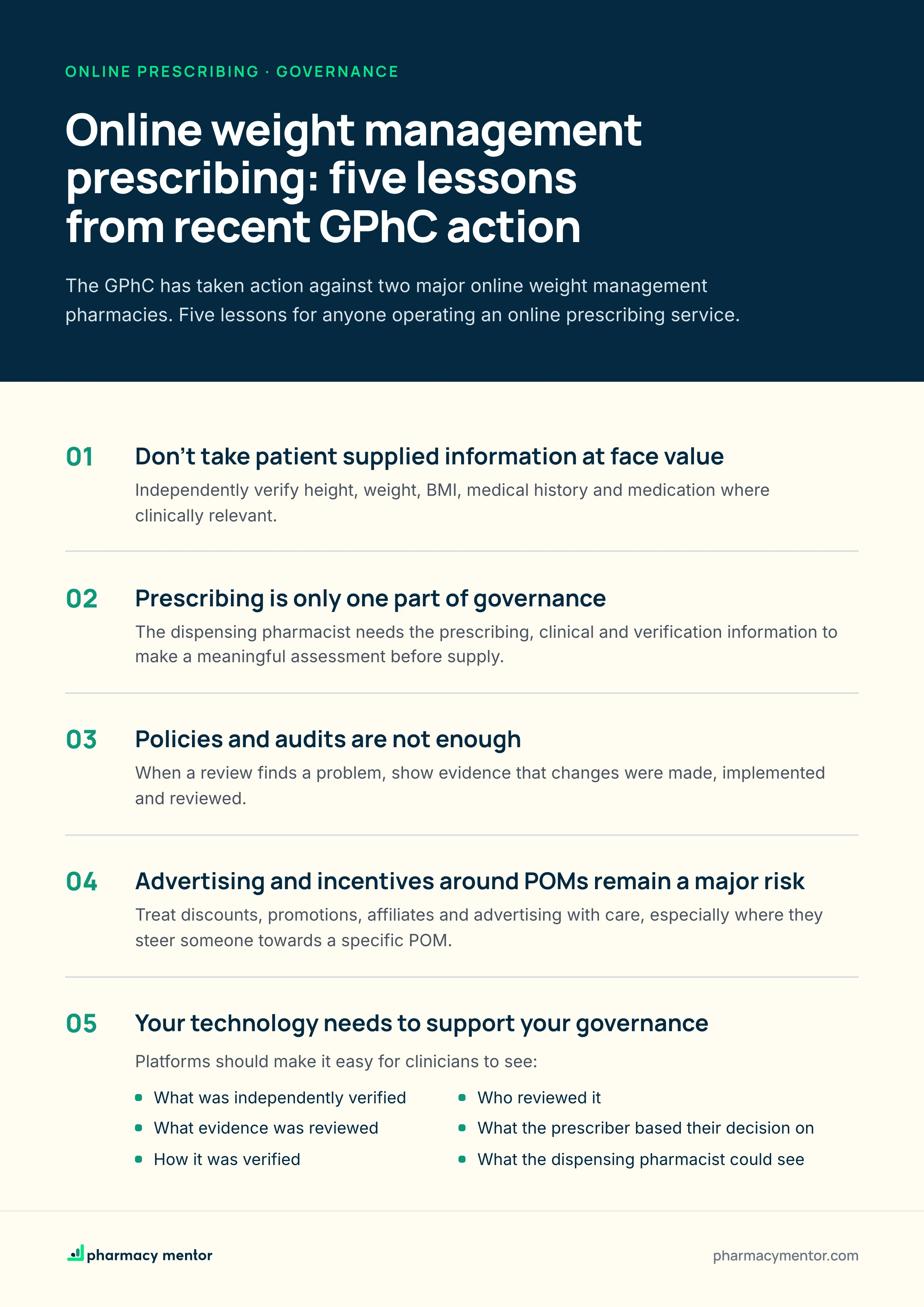
Five lessons stand out: independently verify relevant information, give the dispensing pharmacist meaningful clinical context, act on audit findings, review prescription-only medicine advertising, and make the technology support those responsibilities.
What the published GPhC records show
Voy Pharmacy was inspected on 11 August 2026. The GPhC subsequently issued a statutory improvement notice effective from 11 September, identifying unmet standards 1.1, 1.4 and 2.6. Its concerns included independent verification, advertising and promotional incentives.
Bolt Pharmacy’s 28 July inspection report recorded unmet standards 1.2 and 4.2 and required an improvement action plan. Findings concerned verification, the clinical checking process and whether learning from marketing reviews was implemented effectively.
These are different regulatory actions. Bolt’s published action plan describes proposed changes; it should not be read as confirmation that every change has been completed or accepted as sufficient. This article reflects the records checked on 7 October 2026.
1. Independently verify information before prescribing
An online questionnaire can collect information, but the clinical team still needs to establish whether that information supports a safe decision. Repeating a patient’s answers in another form does not create independent evidence.
The GPhC’s guidance for pharmacist prescribers says weight, height and/or body mass index should be independently verified before prescribing weight management medicines. It identifies routes such as video consultation, an in-person assessment, clinical records or another healthcare provider. A phone call is not an appropriate way to verify those measurements.
The same guidance addresses independent verification of medical history for long-term conditions and conditions requiring ongoing monitoring. The GPhC’s April 2026 weight management review also recommends independently verifying medical history alongside the information needed to determine BMI.
For an operator, the practical question is whether each record shows what was checked, how, by whom and when. Identity verification, image-authenticity checks and verification of clinical measurements have different purposes. A system should make those distinctions clear.
2. Make the dispensing check a meaningful assessment
Prescribing and dispensing are separate stages of the service. The information needed to assess a supply should remain available as responsibility passes between them.
Bolt’s action plan records the inspector’s finding that pharmacists completed an electronic clinical check but did not routinely use the prescribing, clinical and verification information to make a suitable assessment. That finding is relevant to any pharmacy working with a separate prescribing provider.
A useful design exercise is to ask a dispensing pharmacist to review a representative case using the information the system actually provides. Can they understand the prescriber’s reasoning, see the relevant evidence and raise a concern before supply? Or do important details sit in another system?
The GPhC’s distance-services guidance expects risks involving third parties to be assessed and responsibilities to be clear. Agree the clinical information and escalation arrangements alongside the commercial terms.
3. Turn audit findings into changes you can demonstrate
An audit is useful when its findings lead to action. Identifying a problematic advertisement or a missing verification record is the beginning of that process.
Bolt’s inspection findings included concerns about whether learning from marketing compliance reviews was embedded across the service. The wider GPhC weight management review also recommends regular audits and SOPs that staff can access and follow.
One practical approach is to keep an action log recording the issue, its owner, the deadline, the change made and the evidence used to check it. If a marketing review identifies a problem, record the affected advertisements and landing pages, then check the revised versions.
Where the finding concerns clinical assessment or supply, the clinical team should decide what action is needed. Include a later review of real cases so that an updated procedure can be assessed against day-to-day practice.
4. Review POM advertising across the whole journey
Prescription-only medicines, often shortened to POMs, cannot be advertised to the public. The joint CAP, MHRA and GPhC enforcement notice applies that restriction to weight management medicines.
The ASA’s weight-control advertising advice explains that implied references can also breach the rules. An advertisement’s images, wording and linked landing page can collectively promote a POM even where its name is absent. Discounts and affiliate promotions also need careful assessment.
Review the complete route a person follows: the advert or social post, the destination page and any promotional offer. Adding the word “consultation” does not automatically make that route acceptable.
Marketing teams and clinical leads need an agreed approval process and a way to withdraw unsuitable material promptly. The review should cover work created by agencies and affiliates as well as content produced internally.
5. Build GPhC weight loss prescribing guidance into the workflow
A written policy is easier to follow when the platform presents the right information at the right stage. The GPhC’s distance-services guidance addresses accessible records, system risks and auditability. Those considerations belong in the technology brief.
For a practical requirements review, ask whether the system can show:
- the information declared by the patient and the evidence used to verify it;
- who reviewed that evidence and when;
- the prescriber’s decision and recorded reasoning;
- the information available to the dispensing pharmacist;
- unresolved concerns, follow-up arrangements and subsequent changes.
These questions are a starting point for design discussions, rather than a complete regulatory checklist. Your clinical team should define the controls, permissions and escalation rules needed for the service. Test them using realistic cases, including incomplete information and requests that need further assessment.
Technology should help professionals exercise and record their judgement. It cannot guarantee that a prescribing decision is appropriate or that an inspection will be passed.
How Pharmacy Mentor can support the next step
Pharmacy Mentor brings together website development, integrations and pharmacy marketing. We can help translate your clinical team’s requirements into clearer patient journeys and a practical digital brief, while connecting marketing review with the website and landing pages it supports.
If you are considering an ecommerce prescribing platform, The WooPW is one option to discuss against your requirements. Platform selection should follow the service model, with clinical governance and professional accountability retained by the operator and its healthcare professionals.
For wider context, read our GPhC inspection preparation guide. Then choose the most important gap in your own service and agree a specific next step with the people responsible for it.
Start your online ecosystem
Talk to Pharmacy Mentor about connecting your website, clinical workflow and marketing around your pharmacy’s requirements.
Written for pharmacy owners and healthcare professionals. This article supports professional discussion and does not replace current regulator guidance, legal advice or an individual clinical assessment.

Saam Ali
Founder & CEO, Pharmacy Mentor · MRPharmSSaam Ali is a pharmacist, digital strategist and the founder of Pharmacy Mentor. He has worked across community pharmacy, healthcare marketing and digital product development since 2012, helping independent pharmacies build modern online services and reach more patients.