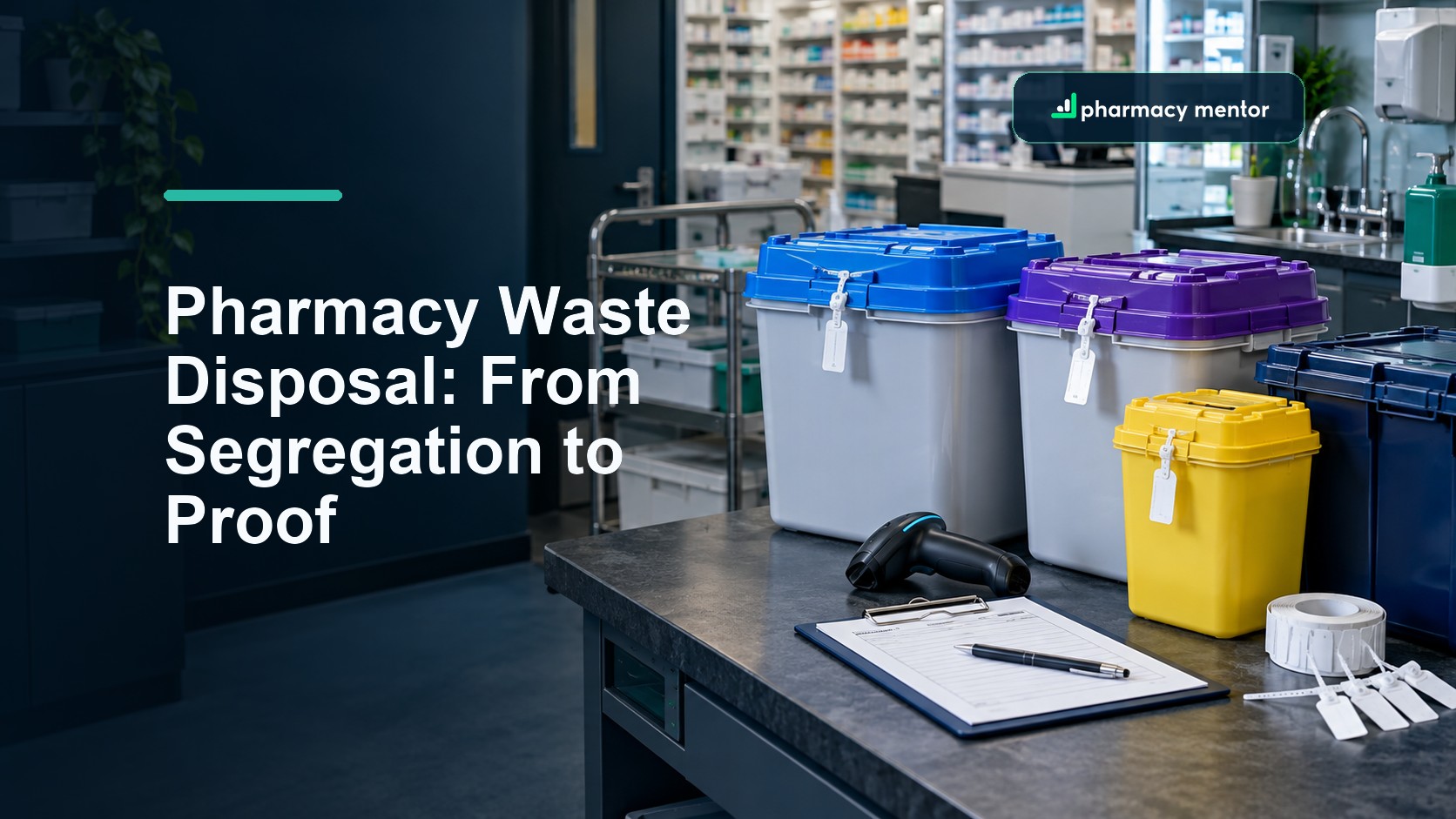
A returned bag of medicines is not one waste stream. Neither is the stock cleared from a fridge, the sharp used during a private service or the confidential paperwork beside a dispensing error.
Pharmacy waste disposal depends on identifying what the waste is, where it arose, which rules apply, how it is segregated, who may move it and what records prove the handover. The bin matters. The controlled route around it matters more.
What should a pharmacy waste-disposal system include?
Map every waste stream by source and classification, use the correct labelled container, keep waste secure, verify contractor and carrier authorisations, retain the required transfer or consignment evidence, train staff on exceptions and review the system whenever services, products, premises or collection arrangements change.
- Separate patient-returned medicines from pharmacy-generated and service-specific waste.
- Do not infer the correct container from appearance alone.
- Keep proof of classification, custody, collection and final route—not just invoices.
Map what becomes waste in this pharmacy
Begin at the points where material changes status. A damaged pack at goods-in, expired stock, a patient return, a recalled item, a cold-chain excursion, a part-used product, a vaccination sharp and confidential paper can arise under different circumstances and need different controls.
Walk through dispensing, retail, consultation services, deliveries, cleaning, maintenance, stock rooms and any associated premises. Include waste created away from the registered site and brought back by the pharmacy. The Specialist Pharmacy Service’s current pharmaceutical-waste guidance notes that collecting unwanted medicines from a patient’s home and returning them to the pharmacy is transport of pharmaceutical waste, with waste-carrier implications.
Connect the inventory to the pharmacy’s risk assessment and stock-control process. A waste contractor can collect a correctly presented container; it cannot decide why the same stock keeps expiring, why damaged goods are not claimed or why a service produces more sharps than forecast.
Separate the NHS essential service from other waste
In England, the Community Pharmacy England service guidance explains that community pharmacies accept unwanted medicines from patients and that the NHS arranges regular collection of those medicines and relevant pharmacy stock waste. It also makes clear that the service does not automatically include other clinical waste such as patient sharps.
Do not assume every item presented at the counter belongs in the NHS-arranged route. Define how staff handle sharps, chemicals, devices, batteries, dressings, illicit substances, general waste, confidential material and waste from privately commissioned services. Record when the team should refuse an item, isolate it safely and obtain advice.
Private clinical services can create waste outside the assumptions of the routine unwanted-medicines collection. Include containers, collection frequency and cost in the service model before launch. Our private pharmacy services guide explains why waste, consumables and governance need to be part of the portfolio decision rather than an afterthought.
Classify before choosing the container
Waste colour systems are useful only when they follow a correct classification. The Environment Agency’s healthcare-waste classification guidance distinguishes cytotoxic and cytostatic medicines, other medicines and different types of contaminated sharps. An asterisk in a waste code marks hazardous waste.
The SPS guide to pharmaceutical-waste containers describes purple-lidded containers for cytotoxic and cytostatic medicinal waste and blue-lidded containers for non-hazardous medicinal waste, with the relevant coding and labelling. It also routes controlled drugs and contaminated sharps to their specific guidance.
| Waste source | Question before disposal | Evidence to retain |
|---|---|---|
| Patient-returned medicine | Is it accepted under the unwanted-medicines service, and does it contain an item needing separate handling? | Current local instructions, segregation process and collection record |
| Expired or damaged stock | Can it be returned or credited, or has it become pharmaceutical waste? | Stock decision, claim where relevant, classification and transfer evidence |
| Private-service waste | Is it a medicine, sharp, infectious item, chemical or ordinary packaging? | Service waste map, contractor scope and container specification |
| Controlled drug waste | What denaturing, witnessing, record and exemption requirements apply to this origin and circumstance? | Applicable register or record, denaturing evidence and authorised collection |
| Confidential material | Does it reveal patient, staff or business information? | Secure-destruction route and supplier assurance |
Use the current national guidance and the pharmacy’s contractor instructions together. Do not rely on a lid colour remembered from another employer or service. If the waste does not match the agreed stream, stop and ask the waste manager or contractor before mixing it.
Keep controlled-drug waste on its own governed route
Controlled drugs need decisions about origin, denaturing, witnessing, records and secure storage before collection. The rules for patient-returned controlled drugs are not identical to those for pharmacy stock, and arrangements can differ across settings and nations.
In England, the Environment Agency’s T28 waste-exemption guidance, updated in February 2026, describes when pharmacies and other authorised people may sort and denature controlled drugs for disposal and the limits and conditions that apply. Check whether the pharmacy needs a current exemption and do not treat registration as a substitute for the professional and legal controls around controlled drugs.
Build a practical route from receipt or stock decision to secure holding, authorised denaturing, record completion and collection. Keep denaturing kits, containers and personal protective equipment available where the SOP expects them, and train staff on what must be escalated to the pharmacist.
Make sharps handling specific
A rigid sharps container does not answer the classification question. Identify whether the sharp is pharmaceutically contaminated, whether a medicine is cytotoxic or cytostatic, whether infection risk changes the route and whether the item arose from pharmacy activity or was brought in by a patient.
Do not compact, force or retrieve items from a sharps container. Set fill limits, closure steps, temporary storage, spill and needlestick procedures, collection responsibility and replacement stock. For a new vaccination, testing or injectable service, forecast container use from expected activity and collection frequency rather than waiting for the first container to become full.
Store waste as securely as the risk requires
Choose a designated area that prevents unauthorised access, leakage, damage, mixing and accidental supply. Keep containers upright, compatible with the contents, closed as required and labelled before use. Separate incompatible materials and protect confidential information on packaging.
Plan capacity for the interval between collections plus a credible delay. A container blocking an escape route or sitting beside usable stock is evidence that collection frequency and storage design do not match the service. Include waste storage when changing the dispensary layout, adding a consultation room or increasing clinical capacity.
For temperature-sensitive stock, link any disposal decision to the documented excursion assessment. The pharmacy temperature-monitoring guide explains why a reading alone does not determine whether stock is usable. Do not discard valuable medicines or return uncertain stock to use without the required product-specific decision.
Verify the contractor, carrier and destination
The waste duty-of-care code for England and Wales says waste holders must take reasonable steps to keep waste safe, transfer it only to an authorised person and describe it accurately. It also advises checking carrier, broker, dealer and site authorisations on the relevant public register.
Ask the supplier to map each pharmacy waste stream to the carrier, receiving facility, permit or exemption, container, documentation and final treatment route. Verify registrations independently and diarise expiry checks. If a broker arranges the service, understand which organisation physically takes possession and where the waste goes next.
- Confirm the legal entity and registration numbers, not just the trading name on a vehicle.
- Check that the receiving site may accept the exact waste codes and properties.
- Agree what the driver will refuse and what happens to a non-conforming container.
- Specify missed-collection escalation, emergency capacity and out-of-hours contacts.
- Understand how containers, labels, consignment notes and replacements are supplied.
Price the full service: containers, routine collection, hazardous streams, ad-hoc pickups, failed collections, overweight items, paperwork, branch charges and contract exit. A headline collection price is incomplete if the pharmacy carries the operational cost of gaps.
Build a record that follows the waste
For non-hazardous waste transfers, the GOV.UK waste-transfer-note guidance describes the information and two-year retention requirement. Hazardous waste movements require the appropriate consignment documentation and different retention controls. Apply the rules for the pharmacy’s nation and waste stream.
Reconcile collections to the containers that left the premises. The record should make it possible to answer: what was it, how much, who held it, who carried it, where was it going, under which authorisation and what happened when the planned collection failed?
Invoices are commercial evidence, not necessarily complete waste evidence. Keep the description, code, quantity, container, transfer date, parties, authorisations and signatures required for the route. Make records easy to retrieve by branch, date and stream.
Train for exceptions, not only routine segregation
Show the team the actual containers and examples they encounter. Then test the uncertain cases: an unlabelled bag, a loose sharp, a leaking bottle, a large quantity of one medicine, an inhaler, a patient’s device, a delivery driver returning medicines, a controlled drug and a product affected by a recall.
The SOP should identify who decides classification, who may seal a container, who arranges collection, who checks paperwork and who investigates a mismatch. Include exposure, spill, damaged-container and collection-failure actions. Record competence through observation, not only a read-and-sign sheet.
Use waste data to improve the service
Measure enough to make decisions: containers by stream, collection frequency, rejected containers, expired-stock value, cold-chain losses, damaged goods, sharps per service and emergency collections. Trends can expose ordering problems, poor rotation, an unsuitable pack size, weak returns processes or a service whose true cost was understated.
Do not reduce waste by moving risk elsewhere. Removing clean outer packaging for recycling can reduce the volume of pharmaceutical waste where current guidance allows it, but medicines, contaminated items and confidential data still need their controlled routes. The priority is correct segregation and safe handling, followed by prevention and proportionate resource use.
Audit one container from origin to destination
Select one recent collection and reconstruct it. Confirm the source, classification, container, label, secure storage, collection request, carrier authority, transfer or consignment record and destination. Compare the written process with what staff and the contractor actually did.
Repeat the trace for the highest-risk stream and after any service launch, premises change, contractor change or significant incident. Update the pre-acceptance audit and contractor information when the waste profile changes; an old audit does not become accurate through repetition.
Pharmacy Mentor helps owners connect new services, technology and day-to-day operations into a commercially workable plan. Explore our pharmacy business strategy support or book a conversation with the team.

Saam Ali
Founder & CEO, Pharmacy Mentor · MRPharmSSaam Ali is a pharmacist, digital strategist and the founder of Pharmacy Mentor. He has worked across community pharmacy, healthcare marketing and digital product development since 2012, helping independent pharmacies build modern online services and reach more patients.