Pharmacy automation has existed since the 1960's, yet full automation is still a long way away for most pharmacies. Automation comes in many different forms, and whilst most articles cover one form or another, this article covers all bases.
Pharmacy Automation includes:- Websites
- Dispensing Robots
- Digital Displays
- PMR Systems
- Prescription Reordering Apps
- Electronic CD Registers
- Prescription Collection Points
- Pharmacy Management Systems
 Get your automating ducks in a row.
Answering the most asked questions around Pharmacy Automation
What does automating mean for a pharmacy?
Automating in a pharmacy isn't just about robots taking over. It means taking repetitive tasks and devising a way to achieve the same outcome without human input. In the industrial age, that meant human redundancies. In pharmacy, that means the staff trained for patient care are now released from the shackles of these administrative tasks. Rather than redundant, they're released for valuable tasks instead of functional tasks.Does automating mean fewer employees in the pharmacy?
No. Automations typically means your staff can spend more time on value-adding tasks that can't be automated, such as customer service and patient care. How many team members do you know that love being in the back room with no windows? Your pharmacy team will almost certainly be happier out in the front, assisting and helping the people in their community. And improving that care leads to higher revenue through cross-selling, and the ability to spend time on private clinical services. Meaning you could even employ more team members.Can the role of a pharmacist be automated?
No. A pharmacist is still needed for their medical judgment and expertise, as well as patient consultations. However, a pharmacist's life can be made considerably easier with automation. Instead of spending their valuable time on administrative tasks, they can be freed up to spend all their time doing what they do best.Which is the best pharmacy automation to start with?
The best place to automate your pharmacy is wherever you and your team are spending the most time. Typically, that will be around prescriptions. But are you spending more time on the phone than you are dealing with the prescriptions? Or would you have more time to answer the phone if you weren't so busy counting pills and updating CD registers? Well, the feedback we get from pharmacies suggests that the majority of phone calls they receive are around prescriptions. Specifically, patients asking when their prescriptions will be ready to collect. There are numerous ways to automate prescriptions.Adding an automated phone message when people call your pharmacy
e.g., "Thank you for calling our pharmacy. If you're calling to find out when your prescription is ready, please download our app/send us an email, where we will get back to you as soon as possible."Dispensing Robots
This is a big one if you have a big prescription business. So much so, it's probably the go-to thing pharmacists would think of when you say the phrase "pharmacy automation." A dispensing robot is invaluable not only in saving you time on dispensing, but also in reducing errors. If you have a village pharmacy where the amount of prescriptions isn't a huge drain on your team's time, it's probably the case that your resources are best spent elsewhere. But if you're dispensing multiple thousands of prescriptions? It's window-shopping for robots time.How do websites automate pharmacy?
Websites have the potential to automate almost every administrative element of pharmacy. Of course, the limitation is budget. Websites can integrate with just about any software with the right amount of development, but there's a sweet spot when it comes to balancing affordability with functionality. And for that reason, I won't go too deep into the potential. We'll focus instead on what most pharmacies can achieve with a website when it comes to automating.Automating Medicine Sales & Clinical Bookings
Websites don't only automate processes for you, they also automate for your patients. Instead of having to visit the pharmacy to collect medication (which doesn't really make sense for a sick person when you think about it), the entire journey can be completed online - even down to risk assessment. Below is an excerpt from our article on How to Build An Online Independent Prescribing Clinic - and it shows how the process of evaluating suitability for POM's & P-line medicines can be done entirely by the patient, meaning you only have to sign it off."For example, a patient ordering Treclin for acne through your website will be prompted to start an online consultation. They're then taken step-by-step through a comprehensive consultation - just like you'd take them through in the pharmacy. Questions don't become answerable until the last one is completed, ensuring 100% accuracy. But this is an example user journey, not the only one. It depends on how the GPhC sees this as regulatorily sound."
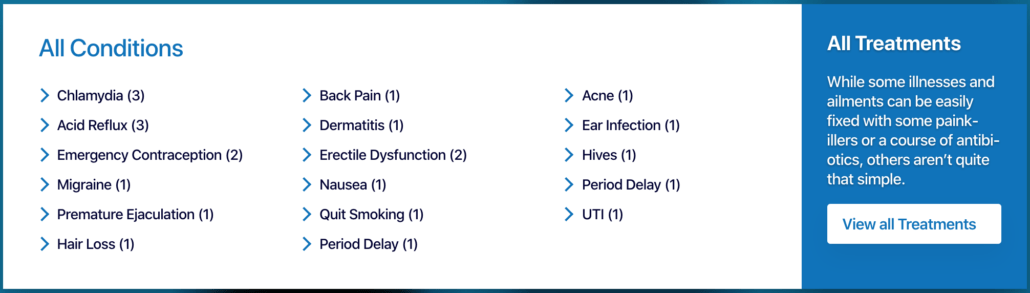 A megamenu from a Pharmacy Mentor website for an Independent Prescriber
Automating Data Collection
How do you ensure when someone visits your pharmacy, or your pharmacy website that they come back again? By adding them to a mailing list, you're giving yourself the opportunity to communicate with the people who've already chosen your pharmacy once. But since we're in the business of automating, you can automate that process too. Any visitors to your website can be prompted to sign-up to your mailing list with a pop-up. What you incentivise this with is entirely down to you, be it signing up to EPS, 10% off their next retail purchase, or special email-only offers. The important thing is you can then re-capture the business. To automate the process for visitors into your pharmacy, you can hand the patient an iPad whilst they wait for their prescriptions (if they're interested in joining your mailing list of course) with a sign-up form. This is what retail stores do as normal practice now.Prescription Collection Points - the new ATM?
Prescription Collection Points were niche only a couple of years ago. But that's the thing about revolutionary tech. It's all early adopters until they start talking about how much it's changed their lives. And Prescription Collection Points have changed pharmacies' fortunes. Some of the busiest pharmacies in the UK are using Prescription Collection Points (plural) to manage tens of thousands of prescriptions - a volume they can only manage with the Collection Points. And a volume they attracted in part by offering the collection service. Take a look at this Case Study we developed that harnessed the power of a Prescription Collection Machine.History repeating itself
It shouldn't be a surprise. This is the exact same function that banks took decades ago with the introduction of the ATM. At the time, the conventional wisdom was there was no way customers wouldn't want to see a bank teller to withdraw money from their account. Now, can you imagine preferring queuing in a bank to using an ATM? Bank staff members were suddenly released from these cash-dispensing jobs, where mistakes in counting were rife, and instead re-allocated to in-depth customer service where they could recommend bank products as solutions to people's financial problems. Sound familiar? Replace money with medicine in that last sentence and you've got yourself an exact parallel with pharmacy. You don't need me telling you that prescriptions are the biggest time sink in pharmacy. So, if you're automating to free up time, a Prescription Collection Point seems like a pretty good place to start.Patient Medication Record Systems (PMRs)
PMRs are commonplace in pharmacies, but that's a bit like saying computers are common in people's homes. Yes, a computer makes your life easier, but if you're still running Windows 95 with dial-up Internet, your life is still significantly harder than someone with the latest software on superfast broadband. PMR systems range from basic medication management software, with clunky interfaces and slow loading times, to state-of-the-art Pharmacy Management Systems which integrate with Dispensing robots and pretty much any healthcare app. Not all PMRs are created equal. Upgrading your PMR system is another potential revolutionary moment for your pharmacy team. Want some guidance on the different PMR systems available? Check out our Ultimate PMR Systems Guide, which explores the offerings from the top providers in the UK.Automating business admin with Pharmacy Management Systems
What is a Pharmacy Management System?
A pharmacy management system is software providing a digital overview of your organisation. It enables reporting, analysing, and informed management decisions that come as a result.What is the difference between a Pharmacy Management system (PMS) and a Patient Medication Records System (PMR)?
Think of a pharmacy management system as your digital business assistant. Anything to do with the business side of a pharmacy business is taken care of there. A PMR system is usually for medication management. It focuses on the pharmacy side of a pharmacy business. Recently, however, the worlds of PMR and PMS are bleeding into each other. Ultimately, it's all software. And software can be programmed to do whatever you need it to. So it shouldn't come as much surprise that overlap is starting to occur between PMR and PMS providers. It certainly makes life easier having everything integrated into one central location.What does a Pharmacy Management System facilitate?
A PMS in Pharmacy can cover pretty much anything you want it to. Often the software is developed bespoke, or for more off-the-shelf solutions you can select module components to build up a system that fits your business model.So how do Pharmacy Management Systems automate your tasks?
The answer is that running your pharmacy business without a Pharmacy Management system is like running your life without a smart phone. Sure, you could. Historically, we did it with no problem. But, with something right there making so many different things accessible and simple in one place, why would you? Pharmacy Management Systems bring all aspects of your pharmacy into one digital space, including but not limited to:- Stock Levels
- Sales
- HR & Training
- SMS Communications & Patient Data
- EPS
Digital Displays
How do digital displays automate pharmacy?
First, let’s refresh the notion of what displaying anything in your pharmacy achieves. The purpose of a pharmacy display is to attract attention to communication/promotion. But what happens when you have multiple things you need to tell your community, or multiple products/services you want to draw their attention to? This is where the dreaded wall of posters usually rears its oh-so-ugly head. And where the messages and promotions all drown each other out into one big noise that nobody pays any attention to.Ok, but what does that have to do with pharmacy automation?
Well, the process of automating your displays conveniently goes hand-in-hand with your objective of communicating effectively, so it’s worth mentioning as an added bonus. With a digital display, all the messages and promotions you want to display can be added to a playlist (including any social media posts you create.) The playlist then automatically loops each message, giving each and every message its own moment in the spotlight. Say goodbye to endless pinning up and pulling down posters when they’re no longer relevant. Just relevant, clear communications, whatever season you’re in. It's smaller automation, but every little helps.Prescription Reordering Apps
What is a prescription re-ordering app?
A prescription re-ordering app is a bit of software that allows patients who sign up for the app to re-order their repeat prescriptions through the app, either on their desktop or mobile. Traditionally these re-orders would either have to be done over the telephone or in the pharmacy.How do they help automate my pharmacy?
Short of integrating something similar into your own website and systems, (which as a bespoke project would cost a lot) Prescription Re-ordering Apps are an incredible reliever of the infamous endless phone calls. Not only does the patient not have to contact the pharmacy over the phone to order the prescription, but they're also alerted when their prescription is ready for collection/delivery. Patients checking whether their prescription is ready is another major source of phone calls, so automating this frees up your team's time (and sanity) from answering those calls.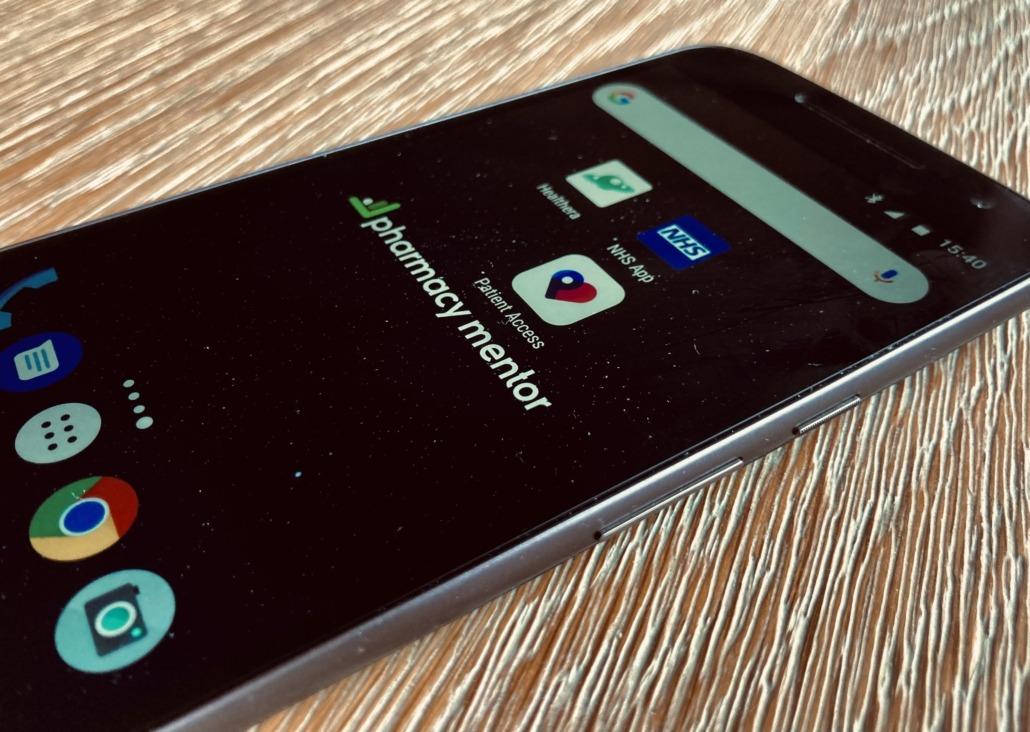 An example selection of prescription reordering apps as they appear on a user's phone.
Are all prescription re-ordering apps the same?
No. Just like any other pharmacy software, different providers have different focuses for their apps, and there is no one-size-fits-all. It's important to consider that the app you select won't just be used by your team, but by your patients. User-friendliness, or lack of it, will reflect on your business. I could go into more depth, but we've already done that. We've written a guide to some of the top Prescription Re-ordering Apps if you want some more guidance for which app to choose for your pharmacy.Electronic CD Registers
To stay compliant with the law, you must account for all controlled drugs on your premise, which isn't news to you. It probably isn't news to you either that you can do all this electronically. Or that this is way more efficient than writing everything down, for a number of reasons:- Everything is recorded automatically, meaning auditing/paper trails are done instantly by just filtering the relevant data.
- Fewer mistakes are made, which means less work chasing up errors.
- Easier mistake rectification. Accidentally dispensed out-of-date medicines? Rather than searching through lots of paper files, you can identify where that medicine has gone at a touch of a button. That said, if you use an Electronic CD register, you probably didn't dispense out-of-date medicines (though mistakes happen!)
 Say goodbye to huge filing systems.
Found this article helpful?
You can automate staying up-to-date on how to market your pharmacy business too. Simply sign up for our newsletter below and start receiving weekly emails with all our latest tips on the best ways to connect your community with your services. [av_hr class='default' icon_select='yes' icon='ue808' font='entypo-fontello' position='center' shadow='no-shadow' height='50' custom_border='av-border-thin' custom_width='50px' custom_margin_top='30px' custom_margin_bottom='30px' custom_border_color='' custom_icon_color='' id='' custom_class='' av_uid='av-1xy4fd' admin_preview_bg=''] [av_mailchimp list='9f6ebc67f1' double_opt_in='aviaTBdouble_opt_in' on_send='' sent='Thank you for subscribing to our newsletter! We hope you'll always find it useful!' link='manually,http://' color='' alb_description='' id='' custom_class='' av_uid='av-a74mcb'] [av_mailchimp_field id='0' label='Email Address' type='text' value='' disabled='' check='is_email' av_uid='av-329mz'] [av_mailchimp_field id='1' label='First Name' type='text' value='' disabled='' check='' av_uid='av-6syh0b'] [av_mailchimp_field id='2' label='Last Name' type='text' value='' disabled='' check='' av_uid='av-2dmaj'] [av_mailchimp_field id='5' type='text' check='' options='' disabled='aviaTBaviaTBdisabled' label='Source' width='' av_uid='av-4ye7kr'] [av_mailchimp_field id='av-button' label='Subscribe' type='button' value='' check='' av_uid='av-2e70u3'] [/av_mailchimp]
About the author
Saam Ali
Founder & CEO, Pharmacy Mentor · MRPharmSSaam Ali is a pharmacist, digital strategist and the founder of Pharmacy Mentor. He has worked across community pharmacy, healthcare marketing and digital product development since 2012, helping independent pharmacies build modern online services and reach more patients.