Understanding GPhC Expectations
The General Pharmaceutical Council expects online pharmacies and prescribing services to have robust systems in place to:- Verify patient identity
- Ensure medicines are clinically appropriate
- Reduce the risk of misuse or diversion
- Protect patient safety
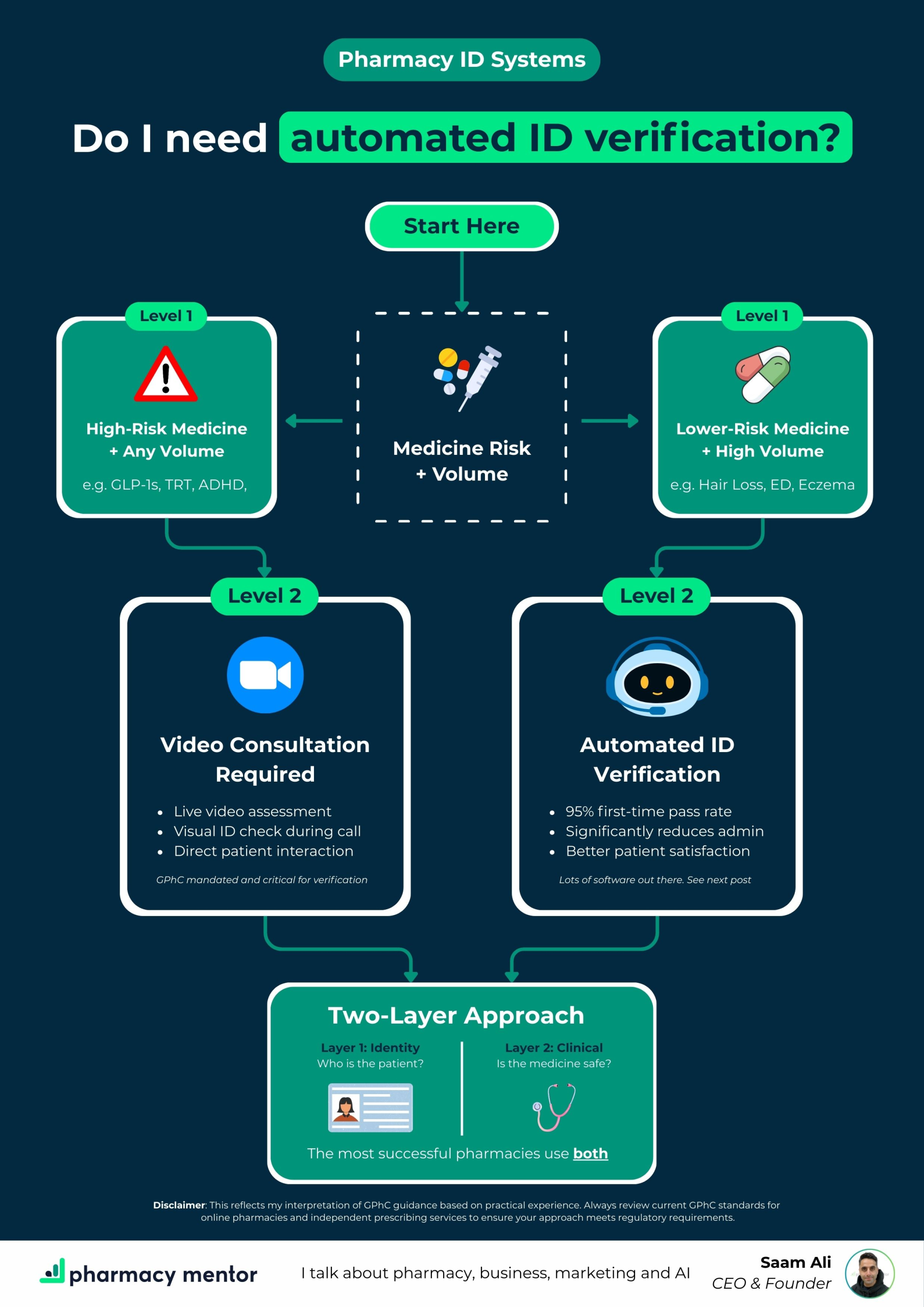
High Risk Medicines And Low Volume
Think about medicines such as weight loss injections, testosterone replacement therapy, or ADHD treatments. These are:- Medicines liable to misuse
- Treatments that require ongoing monitoring
- Higher risk clinical interventions
- A live video assessment
- A visual ID document check during the call
- Direct patient interaction to assess understanding and suitability
What If You Are Doing 500 New Consultations A Week?
Now we shift scenarios. What if you are processing 200 hair loss consultations per day? Let us do the maths.- 200 video calls at 10 minutes each equals 2,000 minutes daily
- That is 33 hours of pharmacist time every day
- That is not scalable
Lower Risk Medicines And High Volume
For lower risk medicines, where GPhC guidance does not mandate video verification, automated systems make operational and financial sense. This includes many services such as:- Hair loss treatments
- Erectile dysfunction medicines
- Certain travel medicines
- Repeat supplies where clinical risk is lower
- First time pass rates above 90 percent
- Significant reduction in manual admin
- Faster patient onboarding
- Improved customer satisfaction
- Seamless identity and address verification
The Decision Framework
If you are unsure whether you need automated ID checking software for pharmacies or video consultations, work through these four questions.-
- What is the clinical risk of the medicine?
- Does GPhC guidance require video verification for this treatment?
- How many new orders are you processing daily?</li>
- Can your team realistically handle manual ID checks at scale?
The Two Layer Approach
To simplify this further, think in terms of two layers. Layer 1: Identity Verification This answers the question, who is the patient? Automated systems such as LexisNexis and similar providers handle this extremely well. They verify:- Government-issued ID documents
- Address history
- Fraud indicators
- Database consistency
Where Pharmacies Go Wrong
The most common mistakes we see are:- Assuming automated ID verification replaces clinical checks
- Overusing video consultations and destroying scalability
- Underestimating staffing requirements for manual KYC
- Not documenting decision-making against GPhC guidance
A Balanced Model For Growth
The pharmacies scaling successfully online tend to follow a balanced model:- Video consultations for high-risk medicines
- Automated ID verification for lower risk, high volume services
- Clear SOPs outlining when each process applies
- Ongoing review against updated GPhC standards