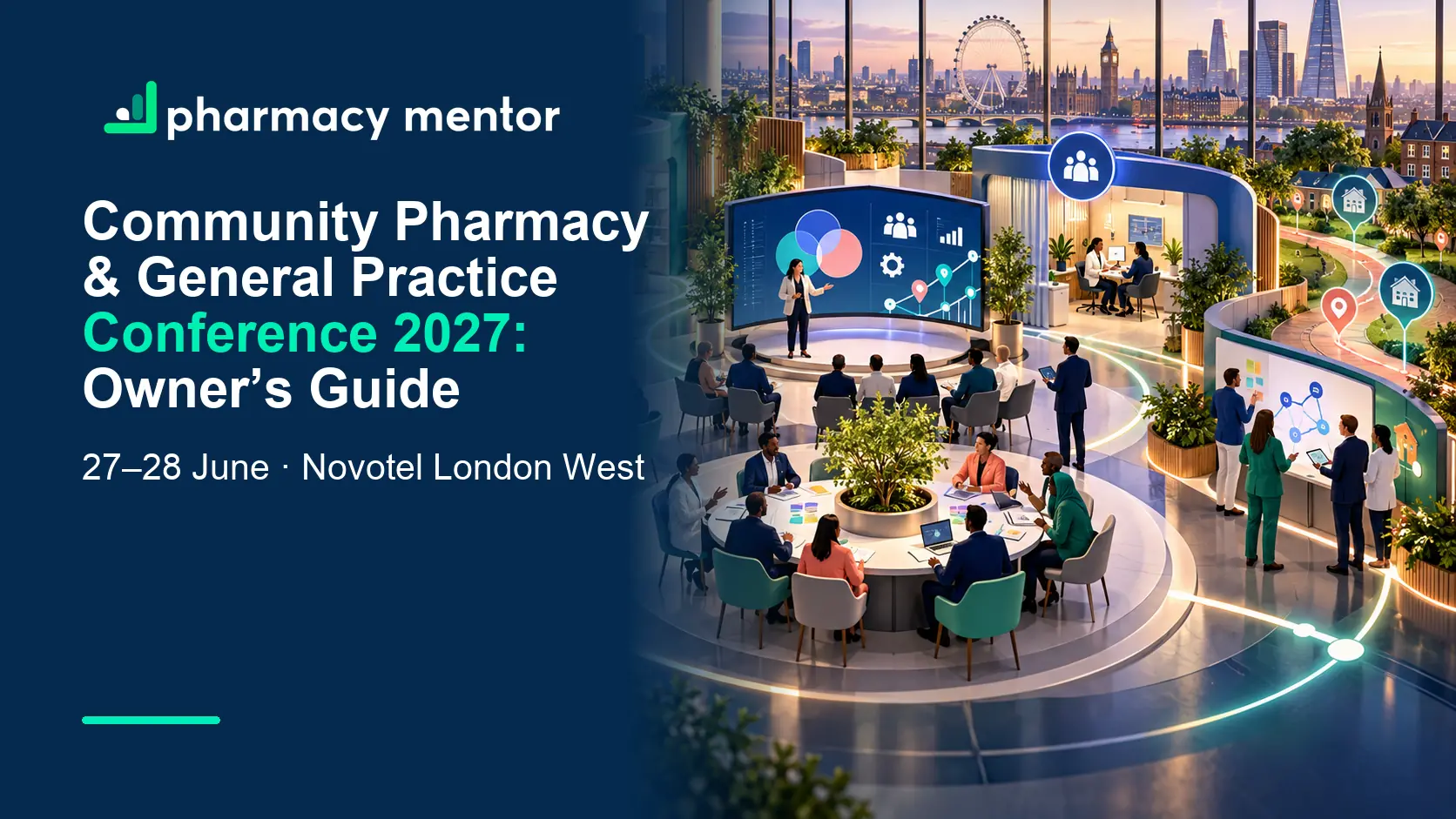
The hand-off between a community pharmacy and a GP practice is where many good service ideas become difficult. A patient moves between teams, information arrives late, eligibility is unclear, capacity changes and nobody owns the final loop back.
The Community Pharmacy and General Practice Conference 2027 is built around that shared primary-care space. For a pharmacy owner, its value will depend on arriving with one pathway to improve—not simply a general intention to collaborate.
What is the Community Pharmacy and General Practice Conference 2027?
The conference is scheduled for Sunday 27 and Monday 28 June 2027 at Novotel London West. The organiser-partner announcement says the free-to-attend event will bring together community pharmacists, GPs and wider primary-care professionals, with more than 40 sessions across clinical services, medicines optimisation, neighbourhood health, workforce and sustainability, technology and AI, and business and finance.
- Map one real pharmacy–general practice pathway before attending.
- Separate clinical responsibility, operational hand-offs and patient communication.
- Leave with an agreed local test, owner, measure and review date.
Confirmed Community Pharmacy and General Practice Conference 2027 details
The Pharmacist’s organiser-partner announcement confirms that the conference will take place on 27–28 June 2027 at Novotel London West. It is held in partnership with The Pharmacist and the National Pharmacy Association.
The announcement says more than 800 primary-care professionals are expected and more than 40 sessions are planned. It identifies six themes: clinical services; medicines optimisation; neighbourhood health; workforce and sustainability; technology and AI; and business and finance. Treat those as the announced shape of the event, not a substitute for the final session programme.
Attendance is described as free for eligible practising healthcare professionals. Use the linked official conference page to confirm the latest programme, registration rules, access arrangements and any changes before booking travel.
Why this conference matters to pharmacy owners
Community pharmacy and general practice often see the same population through different systems, contracts and points in the patient journey. Collaboration is therefore not an abstract relationship project. It affects whether services are understood, referrals are suitable, records are usable, patients know what happens next and both teams can see when a pathway is under pressure.
For owners, that creates commercial and operational questions as well as professional ones. A new pharmacy service may be clinically sound but still struggle if local practices do not understand its scope, the pharmacy cannot absorb demand or patients receive conflicting instructions. Conversely, a clearly designed pathway can reduce avoidable contacts, make capacity more visible and support consistent access.
Use the conference to test assumptions against people working on the other side of the hand-off. The goal is not to persuade every GP practice to adopt a finished pharmacy proposal. It is to understand the shared problem well enough to design a realistic next step.
Bring one pharmacy–general practice pathway, not a broad ambition
Choose one service or patient journey before attending. Map the current route from first contact to completion, including unsuitable requests, escalation, follow-up and feedback. Mark where information changes hands and where each organisation’s responsibility begins and ends.
| Pathway question | Evidence to bring | Conference conversation |
|---|---|---|
| Who is the service for? | Scope, inclusion, exclusion, local need and current demand | Do both teams describe suitable patients in the same way? |
| How does the person enter? | Referral, walk-in, booking and signposting routes | Where is friction or duplication being created? |
| What information is needed? | Minimum dataset, consent, records and secure communication route | What is necessary, lawful, available and usable? |
| What happens next? | Outcome, escalation, follow-up and patient communication | Who closes the loop and how is failure noticed? |
| Can the pharmacy deliver it? | Competence, rota, room, stock, equipment and appointment capacity | What demand can be accepted without weakening the service? |
Connect the map to the pharmacy clinical-governance framework. Collaboration does not transfer responsibility by implication. Each organisation still needs clear scope, competence, records, escalation and review arrangements.
Use the six conference themes as decision lenses
The announced themes are broad enough to become a crowded programme. Give each one a question linked to the chosen pathway.
- Clinical services: which part of the pathway can pharmacy own safely and consistently?
- Medicines optimisation: what information or follow-up would prevent duplication, delay or avoidable risk?
- Neighbourhood health: which local relationships and population needs should shape the service?
- Workforce and sustainability: what competence and capacity are required on both sides?
- Technology and AI: where can a tool reduce work without obscuring accountability or excluding people?
- Business and finance: how will activity, capacity, cost and value be understood?
Select sessions after the full programme is published. A useful mix may include one that clarifies policy or clinical direction, one that shows an implemented pathway and one that addresses the operational or commercial layer. Avoid using the conference timetable as a substitute for your own priorities.
Prepare for useful conversations with general practice
Begin with the shared pressure, not the pharmacy’s solution. A conversation about repeated low-value contacts, delayed access or inconsistent patient information creates more room for joint design than a finished service pitch.
Ask how practices currently identify the problem, what creates avoidable work, what information they trust and what outcome would make collaboration worthwhile. Explain the pharmacy’s constraints just as clearly: competence, appointments, opening hours, service specification, stock, room and follow-up capacity.
Agree language for the patient. “The pharmacy can help” is too vague if the person does not know whether to walk in, book, bring information or return to the GP in particular circumstances. A good pathway explains the next step without promising an outcome that only an assessment can determine.
Keep technology behind the service model
A booking form, shared inbox or AI tool cannot decide the service boundary. Define the pathway first, then test where technology can reduce delay, improve visibility or make the next action clearer. Record who owns configuration, access, data quality, support and downtime.
Our pharmacy booking-system guide explains why availability, reminders, cancellations, accessibility and staff workflow must be designed together. The pharmacy data analytics guide provides a framework for agreeing definitions before two organisations compare results.
If AI appears in a session or supplier conversation, ask which task it performs, what data it uses, how output is checked, where a human decision remains and how an error would be detected. The value is not the label. It is a controlled improvement to the work.
Turn conference learning into a local test
Within one week, reduce the notes to one pathway change. Define the hypothesis, organisations involved, patient group, owner, controls, communication, start and stop dates, and measures. Keep the first test small enough to review honestly.
Possible measures include suitable referrals, booking completion, waiting time, avoidable contacts, pathway exceptions, staff time, patient understanding and completed follow-up. Do not use one headline count to hide a capacity or quality problem. Record balancing measures alongside growth.
Schedule the review before the test starts. Decide what would justify continuation, revision or stopping. Share the outcome with the people who did the work, not only senior stakeholders.
Pharmacy Mentor helps owners connect service design with pharmacy websites, search visibility, bookings, campaigns and operational technology. Explore our pharmacy growth services, or book a consultation to map a patient journey from discovery through delivery and follow-up.
Frequently asked questions
When is the Community Pharmacy and General Practice Conference 2027?
The conference is scheduled for Sunday 27 and Monday 28 June 2027. Check the official event page before travelling in case details change.
Where is the Community Pharmacy and General Practice Conference 2027?
The organiser-partner announcement places the 2027 conference at Novotel London West in London.
Who is the conference for?
The event is intended to bring together community pharmacists, GPs and wider primary-care professionals. Attendance is described as free for eligible practising healthcare professionals; confirm the current registration criteria with the organiser.
What should a pharmacy owner take to the conference?
Bring one mapped service pathway, current demand and capacity evidence, known hand-off problems and the questions that need another organisation’s perspective. That makes sessions and conversations easier to turn into a local test.

Saam Ali
Founder & CEO, Pharmacy Mentor · MRPharmSSaam Ali is a pharmacist, digital strategist and the founder of Pharmacy Mentor. He has worked across community pharmacy, healthcare marketing and digital product development since 2012, helping independent pharmacies build modern online services and reach more patients.