Attention is an opportunity for relationship building, identifying problems, and presenting solutions. A well-planned email campaign gets you regular attention and the results that follow.
Sending emails requires email addresses to send them to. It also requires permission to comply with GDPR. We covered this in our article on Data Collection for Pharmacies, so we won't include it here. But it's definitely worth checking out if you're serious about emails for your pharmacy.
Email Marketing for Pharmacies - Where to start
Probably the first thing to establish in your own head is that email has replaced post for most people. Mail used to be the primary form of communication to people. But the world has changed. If I wrote someone a letter nowadays, I wouldn't expect a response within a week at least. There's no interaction or functionality with a letter. I can't touch it and visit a website. I don't have to store it safely in my house if I want to refer back to it later. It's expensive and time-consuming and it just can't do what emails can. That doesn't mean there's no room for letters in a marketing campaign, but if you sent letters as regularly as you sent emails, it would cost you a fortune and you'd probably get complaints. It's a lot easier to delete an email than it is to throw away a letter. Email Marketing for Pharmacies by Pharmacy Mentor
The benefits of Email Marketing for Pharmacies
Email marketing isn't flash or showy, and that's generally why it's underused. It's private, so it never really gets the publicity of a popular social media post, or a glamorous TV ad. Out of sight, out of mind. But here's why it should be on your mind and on your to-do list...Inexpensive
Even if you value time and have us do it, our admin fee and your email software are the only costs. There's no additional budget necessary. Compared to paid marketing, another fantastic customer acquisition tool, email marketing is inexpensive and generally performs better than any other form of marketing for the investment.Targeted
Splitting your customer base up to personalise and tailor your emails. For instance, customers who come in for clinical services may not have prescriptions. If you're sending them emails about prescriptions, they may unsubscribe. The same is true for any irrelevant communications. There's only so much attention people pay to things that aren't relevant to their interests.Trackable
With most email software, you can track the number of opens, link clicks, and unsubscribes. All these help analyse the effectiveness of the emails. So if something isn't working, you know about it and adapt. And if it is working, you continue doing what works. Combine this with Google Analytics on your website, and you can track where your website traffic comes from. Since marketing effectiveness varies for a whole host of reasons, tracking and analysis are massive.Convenient for mobile and desktop users
Your market consists of both older and younger generations, each with their own preference for devices and software. Almost everyone has an email address and when people check their emails, they often have more time on their hands. (Checking emails replaces the time that less mail through the door has saved, which people only did when they have time to read full letters.)Regular + Relevant = Revenue
For memory's sake, you can break down the three key things you want from an email campaign into 3 R's. Here's why.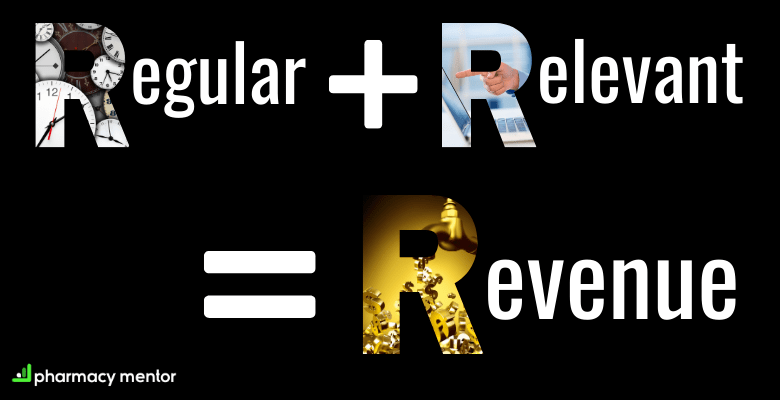
Regular
This doesn't mean every day. Regular means predictable, and as you'd expect. I might expect to hear from a pharmacy once every two weeks. But if I signed up for a holiday deals bulletin, I expect a daily roundup of any deals. The right amount of emails for one person might be too many for another. Like anything in marketing, it's worth testing to see where the sweet spot is in your audience. Of course, you could have a great one-off email you send out and then not send another one all year. This isn't a failure, but it's not maximising success.Relevant
In other words, not spam. Spam targets everyone and hopes it's relevant for some people. You want your marketing lists as relevant as possible. You can segment your mailing list to maximise relevance. People engage more when they feel an email is really speaking to them as an individual. Targeting women for a period delay service? If you segment your mailing list, you can talk in a way women respond to, but men wouldn't.Revenue
If you're not getting revenue, you might as well not show up. It's last because you need the first two before you get it. But ultimately, revenue is the main reason you're marketing in any form. Using call-to-actions is key here. Fortunately, people are familiar with taking action after reading an email, so you're playing into an already existing mindset. As with all aspects of your marketing, you want to be proactively pushing the right services at the right time. It's no good promoting flu jabs in July. We have a Pharmacy Marketing Calendar which we use to develop strategies for your pharmacy if you need help structuring your campaigns.Online Payments
If you're not already set up to take online payments - you should be. Not accepting payments online nowadays is the equivalent of not having a card machine. You lose out on so much customer spend because you can't take their money the way they want to give it.Ready to adopt email marketing for your pharmacy?
Get in touch! We can help with everything you need to get started, including which software works best for pharmacies.We don't just preach this stuff, we practice it! Subscribe to our newsletter for regular updates, including articles like this one and see how we run our own emails. Be sure to check your email for confirmation and always check our Privacy Policy before signing up.
[av_mailchimp list='9f6ebc67f1' double_opt_in='aviaTBdouble_opt_in' on_send='' sent='Thank you for subscribing to our newsletter! We hope you'll always find it useful!' link='manually,http://' color='' alb_description='' id='' custom_class='' av_uid='av-a74mcb'] [av_mailchimp_field id='0' label='Email Address' type='text' value='' disabled='' check='is_email' av_uid='av-329mz'] [av_mailchimp_field id='1' label='First Name' type='text' value='' disabled='' check='' av_uid='av-6syh0b'] [av_mailchimp_field id='2' label='Last Name' type='text' value='' disabled='' check='' av_uid='av-2dmaj'] [av_mailchimp_field id='5' type='text' check='' options='' disabled='aviaTBaviaTBdisabled' label='Source' width='' av_uid='av-4ye7kr'] [av_mailchimp_field id='av-button' label='Subscribe' type='button' value='' check='' av_uid='av-2e70u3'] [/av_mailchimp]

About the author
Saam Ali
Founder & CEO, Pharmacy Mentor · MRPharmSSaam Ali is a pharmacist, digital strategist and the founder of Pharmacy Mentor. He has worked across community pharmacy, healthcare marketing and digital product development since 2012, helping independent pharmacies build modern online services and reach more patients.