The most useful part of an AI stack is not the number of logos in it. It is the work that no longer needs to begin from a blank screen.
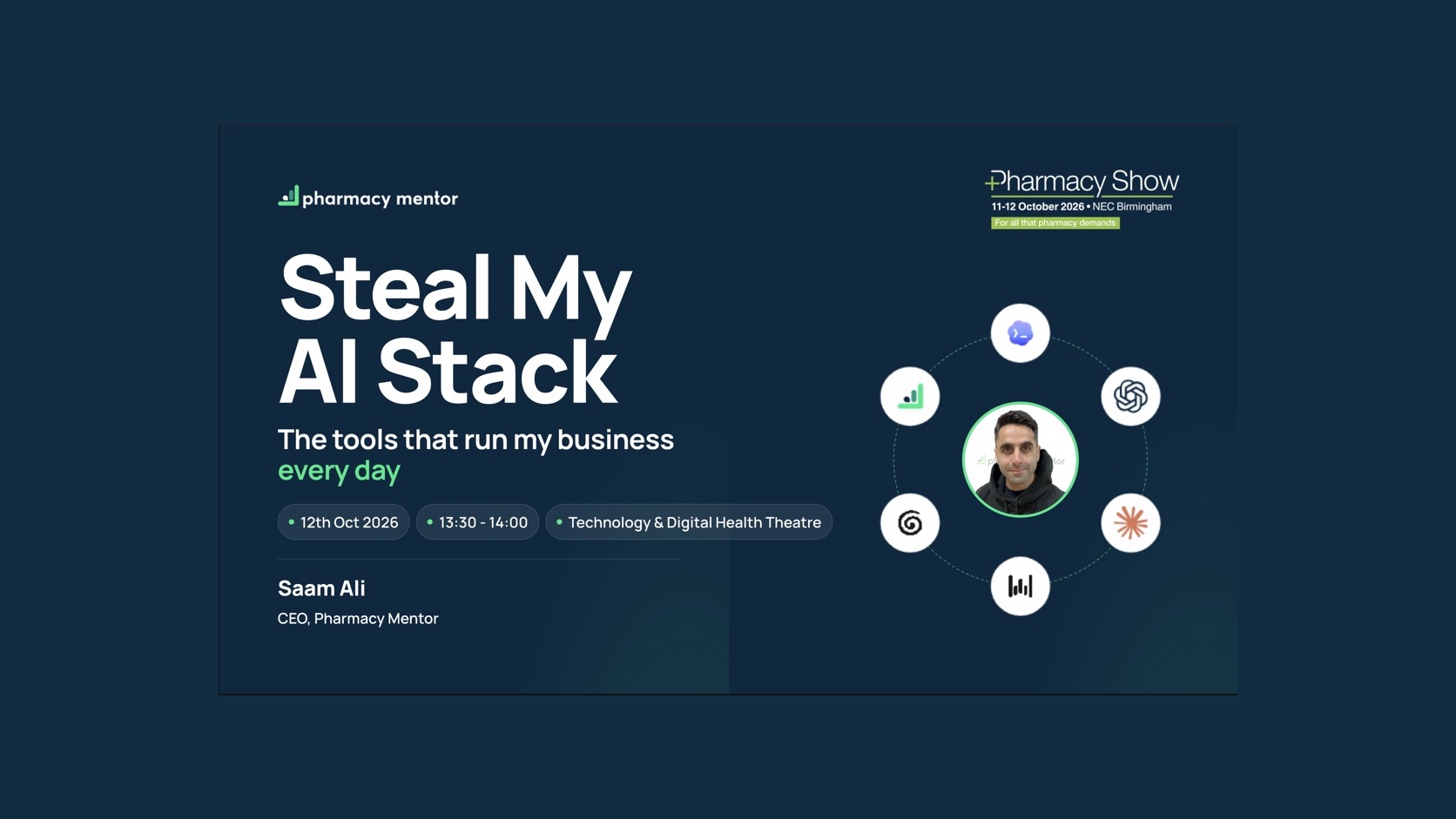
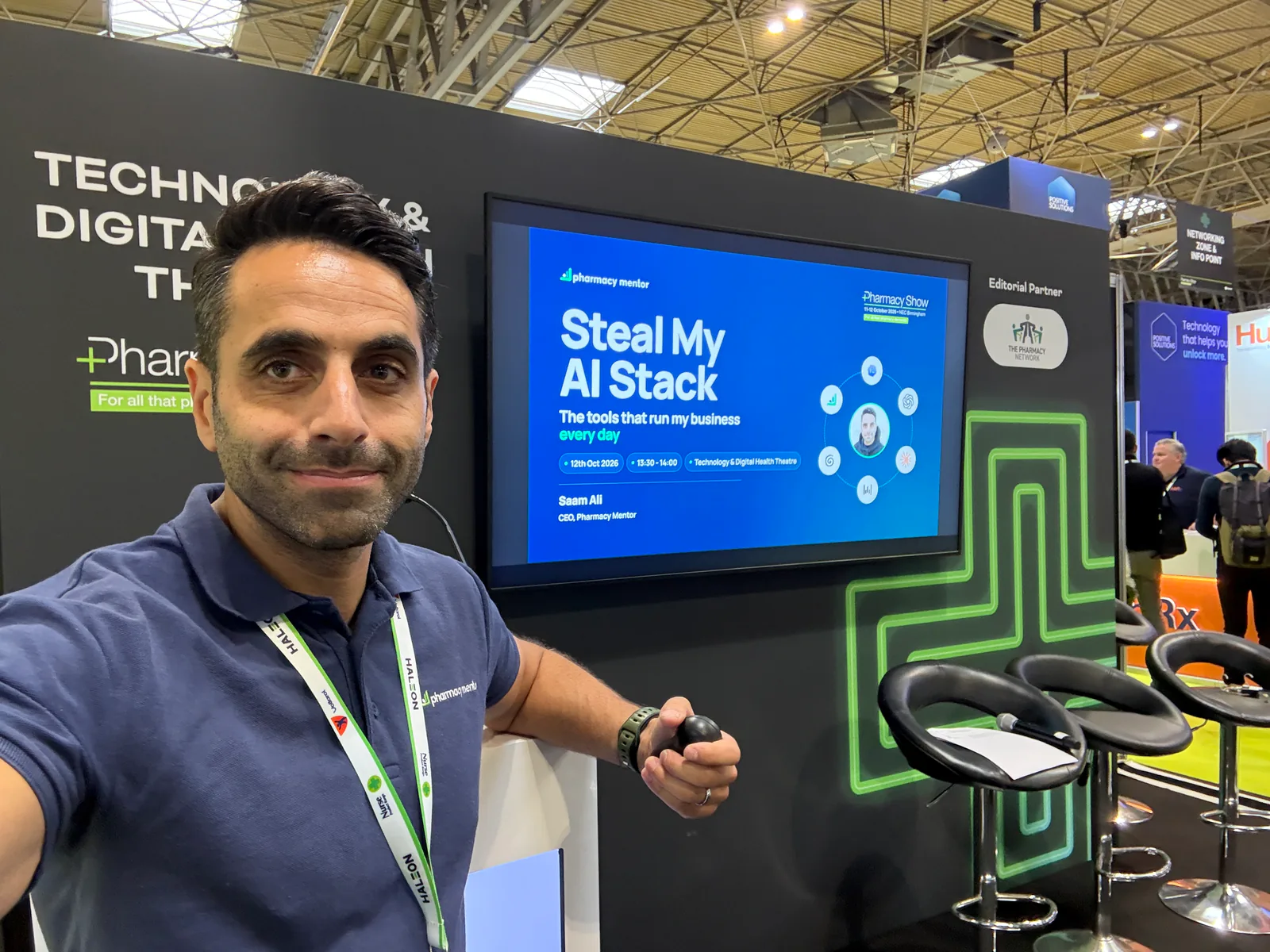
That was the theme behind my second Pharmacy Show 2026 session, “Steal My AI Stack: The Tools That Run My Business Every Day.” The presentation showed the tools I use across thinking, email, meetings, documents, design, dashboards and client delivery. It also explained why copying every tool would be the wrong response.
The stack took years to form. I tried dozens of products, kept the ones that fitted a real working habit and connected them gradually. The practical takeaway for a pharmacy owner was much smaller: choose one recurring task, choose one suitable tool and make that workflow dependable before adding another.
What is the Pharmacy Mentor AI stack?
ChatGPT and Codex form the main thinking and action layer; Claude provides a second view and helps shape polished documents and concepts; Whisper Flow supports voice-first drafting; Granola captures agreed meeting notes; and GrowthHub brings client delivery and free pharmacy tools into one workspace. The important system is the division of jobs, data boundaries and human review—not the product list.
Why the stack is not a shopping list
The presentation began with a hands-free voice workflow used while travelling. By the time I reached the office, the raw script and slide structure had been drafted for review. A task that once involved a blank document, several disconnected notes and a long first pass had become a conversation followed by editing.
That example can sound like the result of one tool. It is really the result of a system: a clear brief, stored context, voice capture, a model capable of organising the material and a human review before anything reaches an audience.
The same distinction applies inside a pharmacy. Buying an AI subscription does not create a useful workflow. The owner still needs to define the job, decide what information the system may use, set a standard for the output and name the person who checks it.
The tools below are the personal stack described during the session on 12 October 2026. Features, availability, pricing and data arrangements can change. Treat the list as a snapshot of one business’s workflow, not a universal recommendation.
ChatGPT and Codex: the thinking and action layer
ChatGPT is where many ideas begin. Instead of using it only for isolated questions, I use it to think aloud, challenge assumptions, structure work and prepare a first version that can be inspected. Codex extends that relationship into action across connected tools and local projects.
The talk illustrated four types of work:
- Inbox triage: separating obvious unsolicited outreach from messages that need attention, with conservative rules and human oversight.
- Diary coordination: checking constraints and preparing routine scheduling actions.
- Business analysis: organising accounting and operational data so a weekly review starts with clearer questions.
- Building internal tools: turning a described workflow into a dashboard or small application that can be tested by the team.
The shift is from asking “what does the model know?” to asking “what bounded task can the system prepare, and what must a person decide?” That is an important distinction for pharmacy. An agent can collect, organise and draft; it should not silently inherit authority that belongs to a pharmacist, prescriber, superintendent, pharmacy owner or data controller.
For a broader view of use cases, see our existing AI tools for pharmacy guide. This article has a narrower purpose: explaining the actual stack behind the Pharmacy Show session.
Claude: a second view and polished output
Claude plays two roles in the stack. First, it acts as a second model when an idea deserves challenge from more than one perspective. Agreement between two systems is not proof, but disagreement can expose an assumption that needs evidence or a human decision.
Second, it is part of the making layer for branded documents, proposals, operating procedures, presentations and early visual concepts. Repeated work is captured as a “skill”: a saved way of working that contains the intended structure, tone, examples and review steps.
The value of a reusable method is consistency. The risk is stale confidence. A saved workflow still needs version control, named ownership and a way to update facts, prices, regulatory references and approved wording. A strong template accelerates judgement; it does not replace it.
The session also showed how an early website wireframe can be produced rapidly once the brand, brief and pharmacy context are available. That can shorten discovery, but it should remain a concept until accessibility, content, privacy, technical feasibility and the actual patient journey have been tested.
Whisper Flow and Granola: capture without losing the thread
Whisper Flow supports voice-first drafting. I dictate a large share of emails, briefs, notes and prompts. Speaking can preserve momentum when typing would interrupt the thought, but the output still needs editing for accuracy, tone and unintended disclosure.
Granola supports meeting notes. In the workflow described on stage, meeting participants are told when the tool is being used. The captured material helps prepare follow-up and reduces the risk that agreed actions disappear into separate notebooks.
A pharmacy should not infer that every meeting or inbox can be connected by default. Before introducing recording, transcription or mailbox access, consider the purpose, lawful basis, transparency, access controls, retention and whether patient, employee or commercially sensitive information is involved. The ICO’s AI and data-protection guidance explains why AI adoption may require an organisation to reassess its existing governance and risk management.
GrowthHub: where the system reaches clients
GrowthHub is the part of the stack Pharmacy Mentor built for pharmacy businesses. It brings delivery visibility, resources and growth tools into one workspace, and it is where the two Pharmacy Show presentations are now available.
The session did not position GrowthHub as a reason to adopt every other product. Its role is to give pharmacy owners one practical place to begin. A free account includes access to pharmacy-focused resources and AI tools, while Pharmacy Mentor clients use the wider workspace to understand activity and next steps.
That makes the presentation download useful as part of the learning journey. The slides are not attached publicly to this article. Join GrowthHub, download the deck there and use it alongside this explanation to decide which single workflow is worth testing first.
The layer no AI stack should skip
My stage presentation concentrated on working habits. A pharmacy implementation also needs a governance layer proportionate to the task.
The GPhC’s April 2026 position statement on AI in pharmacy makes the accountability point explicit. Pharmacy professionals remain accountable for their decisions and actions when AI is used. For owners and superintendent pharmacists, the statement identifies due diligence, risk assessment, data security, confidentiality, staff training, monitoring and review among the expected controls.
A useful pre-implementation check covers seven questions:
- Purpose: what exact job is the tool being asked to do?
- Information: what data does it need, and what must never be entered?
- Authority: can it only prepare, or can it take an action?
- Review: who checks the output, using what evidence?
- Access: which accounts, systems and permissions are necessary?
- Failure: how will the team recognise and contain a wrong or unintended result?
- Evidence: what record proves the process was used and reviewed as intended?
The NCSC’s guidance on AI and cyber security highlights risks including confident errors, bias, prompt injection and disclosure of confidential information. Security is therefore part of workflow design, not a technical check added after connection.
Our AI governance guide provides a fuller control framework, and our pharmacy cyber security guide covers the wider systems, suppliers and access routes around the pharmacy.
Start with one task, one tool, this week
The final recommendation in the talk was to ignore five of the six tools. That is not false modesty. A stack built too quickly becomes another collection of subscriptions, duplicated information and poorly understood permissions.
Choose a task that is frequent, bounded, non-clinical and easy to check. Good early candidates might include turning approved meeting notes into an action list, classifying non-sensitive supplier enquiries, drafting a weekly project summary from a controlled source or converting an agreed brief into a first document structure.
Then run a short evidence cycle:
- Write the current process and the result you want.
- Remove unnecessary personal or confidential information.
- Define what the tool may prepare and what it may not do.
- Test with representative examples, including awkward ones.
- Record corrections, time saved and new risks created.
- Decide whether to standardise, revise or stop.
- Only then choose the next task.
This is how an AI-native operating model becomes defensible. The tools earn their place through repeatable work. The team understands where they help, where they fail and who remains accountable.
For the wider story of the event, see The Pharmacy Show 2026 Roundup. If you want Pharmacy Mentor’s help connecting a defined pharmacy workflow with the right website, automation or growth system, start a conversation with the team.
This article explains Saam Ali’s personal business-tool stack as presented on 12 October 2026. It is not clinical guidance or a product endorsement. Review current vendor terms, data arrangements, security controls and applicable professional requirements before adopting any tool.

Saam Ali
Founder & CEO, Pharmacy Mentor · MRPharmSSaam Ali is a pharmacist, digital strategist and the founder of Pharmacy Mentor. He has worked across community pharmacy, healthcare marketing and digital product development since 2012, helping independent pharmacies build modern online services and reach more patients.