One short TikTok helped an online pharmacy clinic reach around £15,000 in monthly sales within four months. The pharmacy had found a channel that worked, the demand was real and the digital foundations were already in place. Then the team stopped publishing.
That was the opening story in my Pharmacy Show 2026 session, “What Profitable Online Clinics Do Differently”. It was not a story about a failed clinic. The service remained commercially useful. It was a story about the distance between launching an online clinic and building a business that keeps learning after launch.
The talk drew on patterns Pharmacy Mentor has seen while helping to launch close to 100 online clinics. Some grew quickly. Some developed slowly. Others reached an early ceiling. The strongest dividing line was rarely the website alone. It was the operating model around it.
What do profitable online pharmacy clinics do differently?
They treat the clinic as a separate business responsibility, give one person clear ownership, use the first year to learn, focus on a small number of service niches, market consistently and design the patient relationship beyond the first payment. None of those decisions guarantees profit. Together, they create a better environment for controlled, measurable growth.
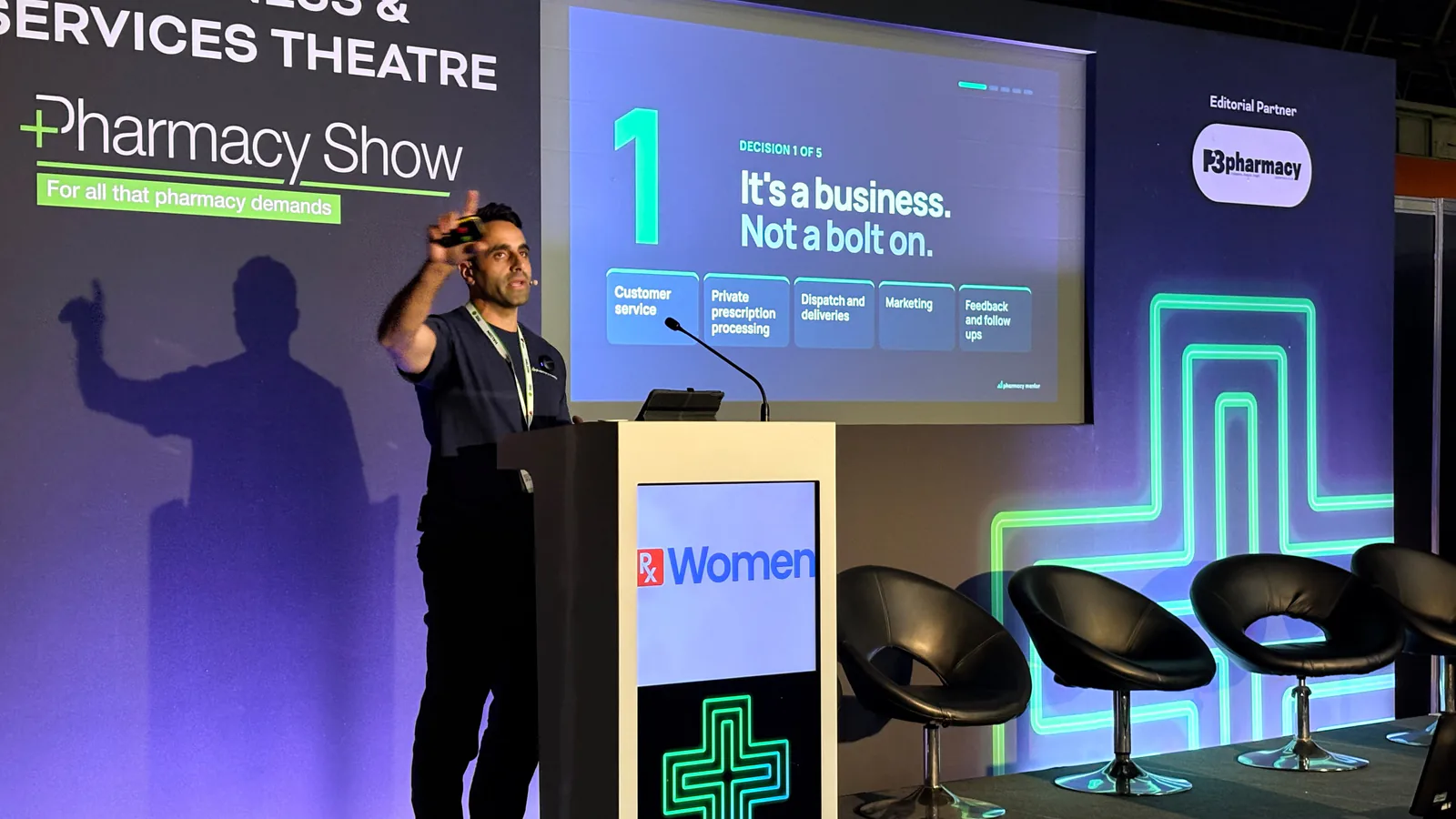
Decision one: build a business, not a bolt-on
A community pharmacy can activate a new service inside an existing business. An online clinic is different when the ambition is to reach patients beyond the local counter and operate at meaningful scale. It creates its own flow of enquiries, assessments, private prescriptions, payments, dispensing work, deliveries, exceptions and follow-up.
The session grouped that infrastructure into six connected responsibilities:
- customer service;
- private-prescription processing;
- dispatch and delivery;
- marketing;
- feedback and follow-up; and
- standard operating procedures that match the service.
A website can coordinate parts of that journey, but it cannot own the work. If a query has no response standard, a Friday delivery exception has no escalation route or nobody monitors abandoned consultations, the technology has exposed an operating gap rather than solved it.
This is why the first planning document should be an operating map, not a feature list. Our online clinic website development guide explains how to map eligibility, consultation, prescribing, payment, fulfilment and follow-up before choosing the stack. The GPhC’s current distance-services guidance should sit alongside that commercial design wherever a registered pharmacy is providing services online.
Decision two: give the operation an owner
The talk contrasted shared responsibility with visible ownership. When an online clinic belongs to everyone, urgent pharmacy work tends to displace it. Marketing pauses, follow-ups wait and small journey defects become permanent.
In one example from the session, an existing community pharmacy launched a separate online brand and trained one team member to champion it. That person owned customer queries, follow-up and the operational detail, with incentives connected to the new business. The clinic reached approximately £100,000 in monthly turnover within six months.
That result is an anonymised first-party example, not a forecast or a typical return. The useful lesson is the ownership model. A named operator could see the whole journey, notice friction and keep the work moving between clinical, dispensing, marketing and customer-service teams.
Ownership does not remove professional accountability from pharmacists, prescribers or the pharmacy owner. It creates a coordinating role. The champion needs authority to investigate issues, a weekly view of the numbers and a clear route for escalating clinical, regulatory, technical and financial decisions.
Decision three: use year one to learn
“Year one is for learning, not profit” was deliberately uncomfortable. A clinic still needs a credible budget and commercial plan, but expecting a clean return immediately encourages the wrong behaviour. Teams cut activity before the evidence is mature, keep weak assumptions because changing them feels expensive, or judge the whole model from a small number of early patients.
A learning year should not mean an unstructured loss. It means agreeing what the business needs to discover:
- which patient need the clinic can serve well;
- where suitable people leave the journey;
- which questions create avoidable support work;
- how long assessment, dispensing and dispatch really take;
- which channel brings patients who continue with the service; and
- what it costs to resolve exceptions, refunds and failed deliveries.
The point is to replace optimism with a measured feedback loop. Review the journey, change one material assumption, watch the result and record what the team learned. Our pharmacy data analytics guide shows how to turn scattered operational data into a weekly decision system.
Decision four: go narrow before going wide
Many clinic catalogues try to look established by listing a very large number of conditions. Operationally, every additional service creates more than a new page. It may introduce different assessment questions, clinical boundaries, suppliers, content, campaigns, support needs and follow-up rules.
The session recommended beginning with one to three focused service niches. That gives the team enough concentration to learn the audience, improve the journey and build recognisable expertise. The exact choice should follow professional competence, governance, supply arrangements, demand evidence and the pharmacy’s ability to operate the pathway. A fashionable category is not automatically the right service.
Narrow focus also improves measurement. If five campaigns and fifty service pages all change at once, the team cannot tell what caused an improvement. Concentration makes the next decision easier to interpret.
Decision five: build a repeatable marketing rhythm
The clinic in the opening story did not need proof that social content could work. It needed a system for continuing. Profitable online pharmacy clinics do not rely on a single lucky post. They build a repeatable rhythm across the channels they can resource properly.
That may include pharmacy SEO, social content, email, SMS, Google Ads, paid social and local offline activity. It does not mean starting every channel at once. A new brand can establish useful content, local awareness, search foundations and retention journeys before increasing paid acquisition. The right sequence depends on the domain, offer, budget, patient journey and evidence.
Every campaign also needs an approval route. Pharmacy advertising can involve professional standards, medicine-advertising rules, platform policies and data-protection duties. Our article on GPhC weight loss prescribing guidance includes a practical review of advertising and landing-page controls in that specific service context.
The champion’s role is important here. Specialist SEO and paid-media work can be supported by an agency, but the operator remains close to patients, local communities and the questions people actually ask. Useful marketing combines that first-hand insight with specialist execution and consistent measurement.
The overlooked decision: design what happens after the sale
Many digital journeys are carefully designed until payment and barely designed afterwards. Yet delivery, service updates, clinical follow-up, reorder prompts, feedback and support determine whether the first transaction becomes a dependable relationship.
The session asked a simple question: who owns the patient relationship when the platform changes? Before choosing technology, an operator should understand data roles, access, portability, records, permissions and exit arrangements. Those questions need clinical, legal and information-governance input; they should not be left until a supplier relationship ends.
Retention is also an operating outcome. A clinic that understands the reasons for repeat use, non-continuation, complaints and delivery failures can improve the whole service. A clinic that sees only completed payments is managing a checkout, not a patient journey.
Our ecommerce prescribing clinic guide explores the connected technology behind assessment, prescribing, dispensing, payment and fulfilment. The business model still needs people and processes capable of operating every connection.
Score the operating model honestly
The final part of the talk turned the five decisions into an honest readiness score. The purpose was not to create a badge. It was to expose gaps before they became expensive.
A pharmacy considering an online clinic can begin with ten questions:
- Is the clinic treated as a separate commercial and operational responsibility?
- Does one named person coordinate the complete journey?
- Can the business resource learning and improvement through the first year?
- Is the initial service scope deliberately narrow?
- Are the clinical and operational responsibilities documented?
- Is there a marketing rhythm the team can sustain?
- Does every campaign have an appropriate approval route?
- Can the operator measure acquisition, capacity, exceptions and retention?
- Are data access, portability and supplier exit understood?
- Is the after-sale journey designed as carefully as the checkout?
A low score is useful information. It identifies work to do before launch or before adding more demand to an unstable journey. A high score is not a guarantee; it means the business has fewer avoidable gaps between the idea and its execution.
If the session has exposed an operating or technology gap, Pharmacy Mentor can help define the model before building the journey. Explore our pharmacy growth services or speak to us about a focused online-clinic project.
This article explains a Pharmacy Show business session for pharmacy owners and operators. Examples are anonymised first-party experiences, not financial promises. It does not replace current regulatory guidance, legal advice or professional judgement.

Saam Ali
Founder & CEO, Pharmacy Mentor · MRPharmSSaam Ali is a pharmacist, digital strategist and the founder of Pharmacy Mentor. He has worked across community pharmacy, healthcare marketing and digital product development since 2012, helping independent pharmacies build modern online services and reach more patients.