A successful eCommerce website massively expands your customer base and increases spend from your existing customer base. How? By putting you in front of their faces when they're ready to buy.
Online sales rise continually year on year, but if you don't have a pharmacy eCommerce website, you won't see a penny of it.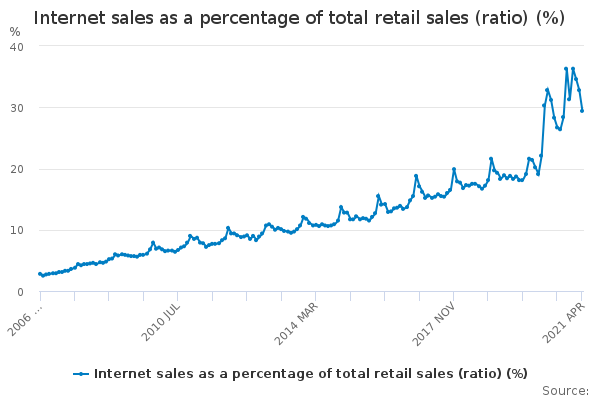
The components of a successful Pharmacy eCommerce Website
This article is a recipe for sweet success when it comes to eCommerce. But what are the key ingredients you need for the delicious end result?- Information-rich product pages/descriptions
- Simple (and secure!) checkout process
- A good eCommerce platform
- Customised design for your specific business
- Intuitive and convenient categorisation & navigation around the online shop
- A mobile-responsive version of the site.
- SEO
How Pharmacy eCommerce works
Pharmacy eCommerce is about taking your pharmacy business online. Not just the marketing, but the actual sales themselves. We're not talking about just booking services anymore, but setting up a full online store with products, payments, and postage. For your customers, this means they can buy from you without ever leaving their homes. Super convenient. For you, this means expanding your business beyond the previous geographical limits. Check the case study below for an example of what success looks like with a pharmacy eCommerce website! [embed]https://www.pharmacymentor.com/case-study-helping-a-pharmacy-make-over-220000-per-month-via-e-commerce/[/embed]The present and future of eCommerce
In 5 years' time, you'll wear a pair of glasses that connect to your temples. When you think about something you need, the glasses bring up an option to order it straight away from the most relevant supplier. Ok, I made that up. But only to prove a point. Because that's essentially how Google works already. And increasingly, how audio works. Let me explain. If you already know how Google and smart devices work, skip the next two headings.eCommerce on Home Voice Devices
This is how easy ordering products online with smart household devices is.- Start an order, say something like “Ok Google, buy Ibuprofen.”
- Google reads off the top search results and asks for confirmation.
- Say “Yes” to order, or “No” to get the next search result.
 Smart Home Devices are increasingly used across modern households.
Pharmacy eCommerce websites on Google
We've talked many times about how when people need something and they don't know where to get it, Google is where they go. And so ranking highly on Google is critical to any eCommerce strategy. I won't go into too much detail here, but if you want to understand why ranking on Google is so important to your strategy, read this pharmacy guide to winning Google.
The additional element you need for eCommerce is optimising those product pages. Pertinent information and relevant product descriptions helps Google index your site, as well as giving a great shopping experience. The combination of those two means you'll rank well on Google and will reap the profits as a result.
Creating a successful Pharmacy eCommerce website
Now we understand how they work, it's time to follow our recipe for creating that successful Pharmacy eCommerce website.Firstly, select the right platform
We use WooCommerce, because of its seamless integration into WordPress sites. What this means is the complete functionality of WordPress with your shop. Why is that good? Glad you asked. Just for absolute clarity - an eCommerce platform is not the same as a website. So, using WooCommerce (eCommerce platform) because it works well with WordPress, means you can create an entire website with eCommerce, rather than just one or the other.Next, Customise your Website
This is important for your shoppers and your pharmacy business too. Once we've got our platform, it's time to think about how it appears online. Customising its appearance and structure makes a massive difference.For happy customers
Your online shop should be as distinguished an experience as shopping in your pharmacy. That's not to say it's the same level of experience. But just as you'd hope to give someone a better experience than your competition, you should strive to deliver a better experience than your competition.For an efficient pharmacy business
Customising your website for the way you work is another cornerstone for success. Because the website is only the front of the business, like a physical pharmacy building. It still requires work behind the scenes to deliver on the orders. Understanding how you operate and incorporating that into the website is critical. On the customer side, it ensures excellent service. From your side, it prevents administrative workload issues. Further than that, the right website design brings a level of automation that improves the profitability of your overall business. There are also different models and focuses of pharmacies now. Customising a website with these focuses in mind is important. The difference between success and irrelevance can be fine margins. The devil is often in the details. See that in action as we build an eCommerce solution for an Aesthetics pharmacy in the case study below. https://www.pharmacymentor.com/impact-study-building-an-e-commerce-solution-for-an-aesthetics-pharmacy/Website Design
Now it's time to think about presentation. The eCommerce platform was the skeleton, your customised website is the muscles, now it's time to put the skin on and make the whole thing look pretty. Interactive and responsive design, including contemporary look-and-feel, good usability and high-quality graphics is the pinnacle. If people don't feel like your website is up-to-date, it won't inspire confidence that your products or services are. I've seen websites look so dated, I didn't buy from them in case it was a business that didn't even trade anymore. I wouldn't want my money going somewhere unless I'm sure I'm going to get the product.Cultivating the intuitive navigation and layout
Presumably you put thought into the layout of your pharmacy. Where products go, what signs you use for different sections, like Prescriptions, Skincare etc. More recently you've implemented one-way systems and social distancing stickers on the floors. This all needs doing for your online shop. Don't forget the number one reason people are shopping online in the first place - convenience. Making your website as easy as possible to find both the products that people are visiting specifically to buy, as well as recommending similar or alternative products mirrors the journey they'd experience in your pharmacy.Creating a product ecosystem with integrated SEO
Product ecosystems are simply products that interlink with each other in some way. Think Apple's iPhone, Airpods, and Apple Watches. If you have one, chances are you'll want the others.
Product ecosystems help both the buying journey and the Google ranking, so it's a must for any pharmacy eCommerce website. Linking optimised content with relevant, optimised product pages sounds technical, but it's really simple in concept.
All it means, translated into simple terms, is that you're combining the information and advice with your product, as well as linking relevant products. Buying throat numbing spray? You might also be interested in Vapour Rub, Lemsip, and Lozenges.
Including a "How-to-use" guide (or similar) with your product not only helps people to find you on Google, but also instills confidence in the purchase at the moment of decision-making.
Having the relevant information on your product pages boosts your Google rankings too, the same way blog articles and other web pages rank higher with well-organised and relevant information.
Safe & Simple Checkout Process
Picture it. You pop into the supermarket and pick up a carton of juice for the morning. You get to the checkouts and it's like Christmas Eve, every checkout has at least three packed trolleys. Do you wait half an hour to buy that juice? Of course you don't. Because you don't have the time. So you leave. You head to a corner shop and pick up juice there. The woman behind the counter says they only accept credit cards. She pulls out a machine that doesn't look anything like a normal card machine. She says she'll need to take a photo of your card for security and your signature. Again, you put down the juice and say it's ok, you'll go somewhere else. These are parallels by people's experiences when giving up online. Even if the website was modern enough to attract the customer and simple enough for them to quickly find what they needed. If the checkout process isn't simple and secure, you lose customers. Bear this in mind when selecting an online payment gateway for your pharmacy.Mobile-responsiveness is now Mobile-First
Once upon a time, optimising for mobile might have been the icing on the cake. Now it's the self-raising flour. Without it, your website will fall flat. Google recently changed its algorithm, which is the system it uses to analyse and rank websites. Now, your site is judged on the experience it gives to mobile users. This is MASSIVE."If it's your intention that the mobile version has less content than the desktop version, your site may lose some traffic when Google enables mobile-first indexing for your site, since Google won't be able to get the full information anymore." - developers.google.comWhy this is important is that you could previously heap tonnes of information onto the desktop version of your site, be judged on that, whilst your stripped-back, simplified mobile version would cruise off the success of your desktop site. Now, that isn't the case. This makes it slightly more difficult to strike the balance between informative content and sleek design. You want the information there, but you want to avoid the dreaded "wall of text" that puts off so many users from websites.
Necessary, but desirable
Whilst the Google update now makes Mobile-Friendly websites imperative, the number of mobile users shopping online should be the real incentive. That one word again. Convenience. If there's one thing you take away from this article, make it that convenience rules supreme online.Of course, there is another way...
Just like a recipe, you can take this, and use it to create your own dish. (Though you'd need the technical know-how on top.) Or, if you'd prefer, the Pharmacy Mentor MasterChefs can whip up a mouth-watering eCommerce solution for your pharmacy. We work with you, understand exactly what it is you need, and produce it. Just like we've done countless times for other community pharmacies. [av_hr class='default' icon_select='yes' icon='ue808' font='entypo-fontello' position='center' shadow='no-shadow' height='50' custom_border='av-border-thin' custom_width='50px' custom_margin_top='30px' custom_margin_bottom='30px' custom_border_color='' custom_icon_color='' id='' custom_class='' av_uid='av-1xy4fd' admin_preview_bg=''] [av_mailchimp list='9f6ebc67f1' double_opt_in='aviaTBdouble_opt_in' on_send='' sent='Thank you for subscribing to our newsletter! We hope you'll always find it useful!' link='manually,http://' color='' alb_description='' id='' custom_class='' av_uid='av-a74mcb'] [av_mailchimp_field id='0' label='Email Address' type='text' value='' disabled='' check='is_email' av_uid='av-329mz'] [av_mailchimp_field id='1' label='First Name' type='text' value='' disabled='' check='' av_uid='av-6syh0b'] [av_mailchimp_field id='2' label='Last Name' type='text' value='' disabled='' check='' av_uid='av-2dmaj'] [av_mailchimp_field id='5' type='text' check='' options='' disabled='aviaTBaviaTBdisabled' label='Source' width='' av_uid='av-4ye7kr'] [av_mailchimp_field id='av-button' label='Subscribe' type='button' value='' check='' av_uid='av-2e70u3'] [/av_mailchimp]
About the author
Saam Ali
Founder & CEO, Pharmacy Mentor · MRPharmSSaam Ali is a pharmacist, digital strategist and the founder of Pharmacy Mentor. He has worked across community pharmacy, healthcare marketing and digital product development since 2012, helping independent pharmacies build modern online services and reach more patients.